Google's AI Mode Has Been Live in France Since July 2026: What It Means for Your Website
 By Thierry Gustin
Updated
7 min read

Contents
Google AI Mode has been available in France since Wednesday, July 22, 2026, launching at the same time as AI Overviews[1]. It is a conversational search tab, powered by Gemini 3.5, that answers by writing a summary with links and accepts follow-up questions. For a website, it does not replace traditional rankings, but it adds a new way to be found, or ignored, and a new setting in Search Console.
Looking back from November 2026, it is easier to see what this launch changed for a small or mid-sized business. The traffic numbers for AI Overviews are covered in a separate article; here I focus on the product itself: what searchers see, what Google has given site owners, and the decisions a French business (or a Spanish one, which has been living through the same thing since 2025) needs to make.
What exactly is Google's AI Mode?
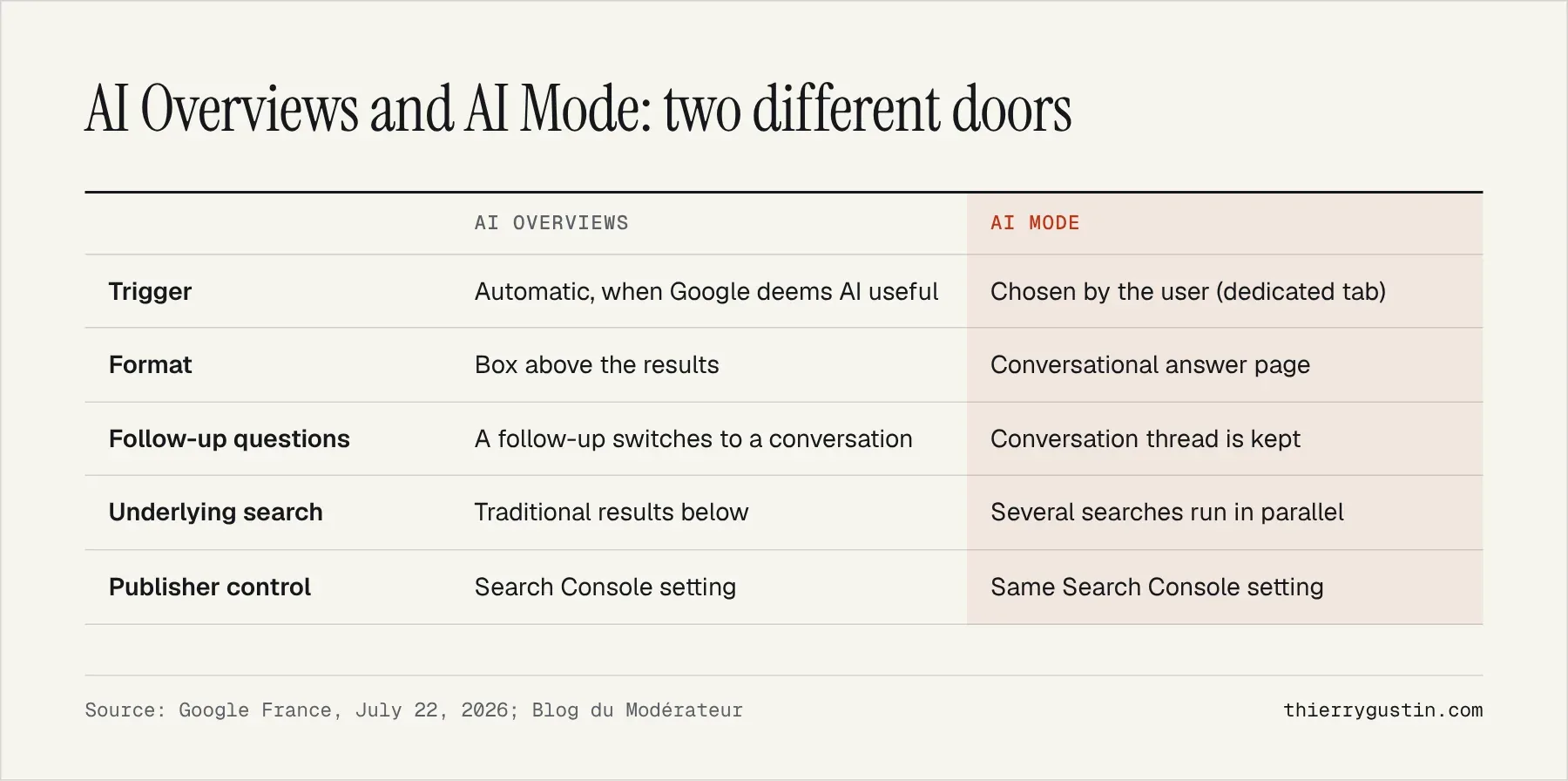
In his July 22 post, Sébastien Missoffe, managing director of Google France, presents AI Mode as Google's most advanced search experience. You can query it by typing, by voice or with an image. The answer is written out, with “clearly visible” links to the web and suggested follow-up questions[1].
The inner workings matter more than the packaging. Google explains that AI Mode breaks a question down into subtopics and runs several searches in parallel (a technique known as query fan-out), then assembles the result. It also keeps track of the conversation: you can ask for a comparison table, then refine it. According to Google, an AI Mode query is on average three times longer than a traditional search[1].
In the interface, AI Mode has its own tab next to Images, News and Videos. You can also enter it from the home page or from an AI Overview box, on the web as well as in the Google app for iOS and Android[2]. The search box itself has changed too: it grows with the length of the question and accepts images and files[1].
Why did the launch take so long in France?
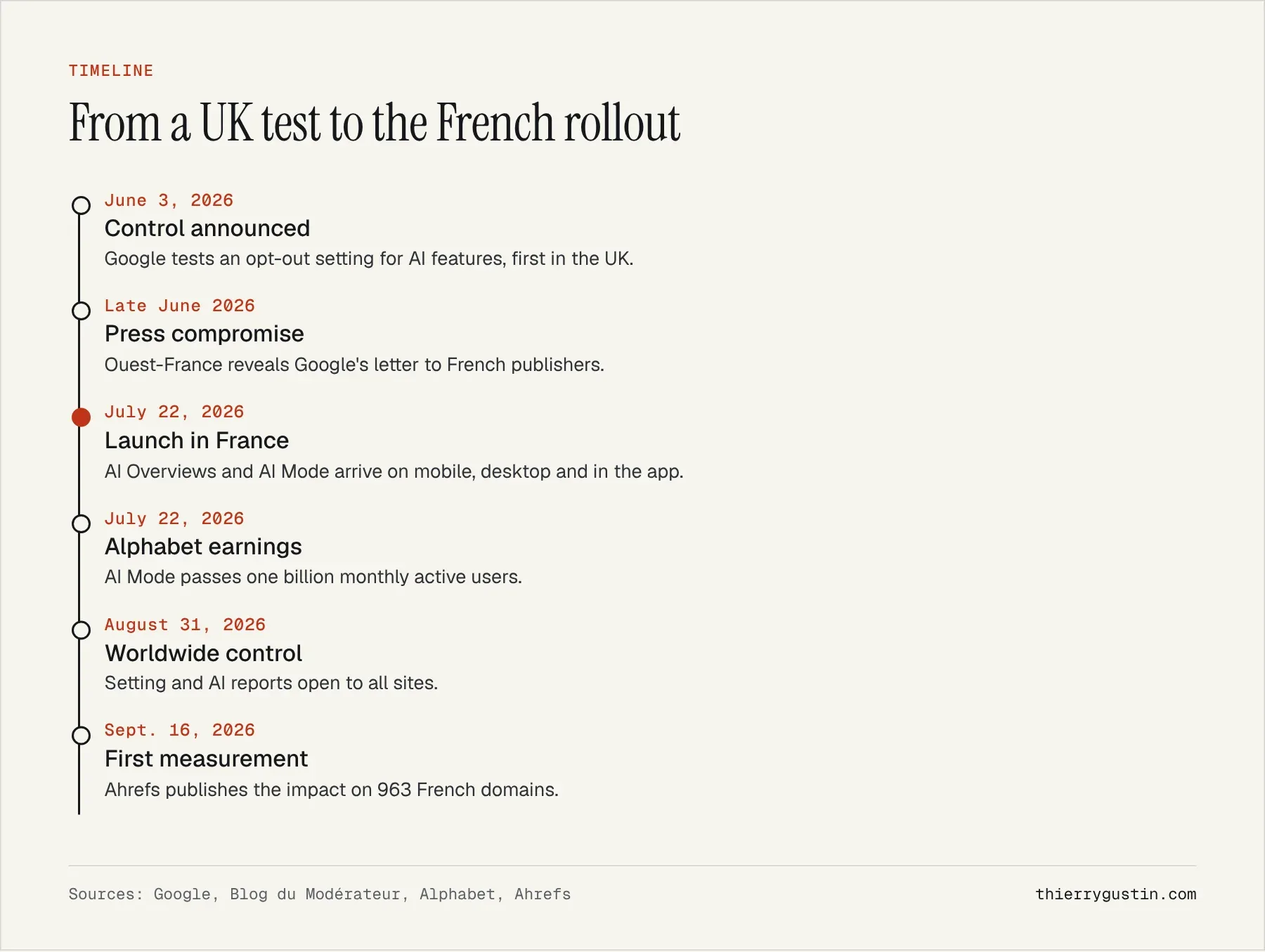
AI Overviews have existed in the United States since May 2024. France was one of the few markets without these features, because of the dispute over press publishers' neighboring rights; the French Competition Authority had fined Google €250 million in March 2024[2].
The deadlock was broken through a compromise with publishers, revealed in late June by Ouest-France and reported by Blog du Modérateur: publishers can remove their content from AI Overviews without any ranking penalty, and the 450 media outlets under contract with Google are paid when their content is used there[2]. I have not read that letter myself; these details come from the trade press, not from an official Google document.
Is AI Mode actually being used?
Google says yes. On the very day of the French launch, Sundar Pichai said during Alphabet's quarterly earnings that AI Mode had surpassed “1 billion monthly active users”, and that Google sends “billions of clicks” to websites every week through its AI features[3]. Google does not, however, publish any click-through rate.
Independent data calls for caution about real-world usage. According to SparkToro, based on the Similarweb panel, only 0.34% of Google searches in the United States ended up in AI Mode between January and April 2026[4]. The two figures do not necessarily contradict each other: many people can try it every month without making it their main way in. But they are a reminder that traditional search and AI Overviews are still, by far, what your customers see.
For France, the only solid measurement I know of is Ahrefs' September study of 963 domains: it covers AI Overviews, with a 23.1% drop in click-through rate for the most exposed sites[5]. I go into its scope in my article on the impact of AI Overviews on your traffic.
Should you use the new Search Console control?
This is the real novelty for site owners. Google has added a setting to Search Console that lets you choose whether your site appears in AI Overviews, AI Mode and AI features in Discover, and whether it is used to ground their answers. Announced as a test on June 3, it has been available to every site worldwide since August 31, 2026[6]. Google France's post presents it as available to French sites[1].
The consequences are spelled out in black and white: “Sites that opt out will not receive traffic or impressions from our generative AI features.” In other words, a site that opts out gets neither traffic nor impressions from these features. Google does state, however, that this choice is not used as a ranking signal in traditional results[6].
The same move brought a dedicated report: your pages' impressions in generative AI features, by page, country, device and date[7]. It is still limited (no clicks), but it is the first official measurement of your presence in these answers. I explain it in detail in the article on the generative AI performance report.
My take
For a small business, I almost always advise against opting out. The setting makes sense for a news publisher whose model depends on people reading the article itself, and which is negotiating payment on top of that. For a law or accounting firm, a tradesperson, a hotel or a software company, disappearing from AI answers means leaving the field to a competitor who will be cited and recommended instead.
The second point is about the shape of queries. Questions three times longer, broken into sub-questions, favor pages that precisely answer a specific case: “which tax regime for a freelancer invoicing in Spain” rather than “tax regime”. Sites with detailed service pages, real FAQs and customer case studies have a structural advantage.
Finally, I remain measured about the immediate effect. AI Mode is an extra door, not yet the main one. The mistake would be to rewrite everything “for AI”: Google itself repeats in its May guide that optimizing for its AI features is still SEO[8], as I pointed out about the official May 2026 guide.
What should you actually do?
Here is the approach I have been using with my clients since the summer, in this order.
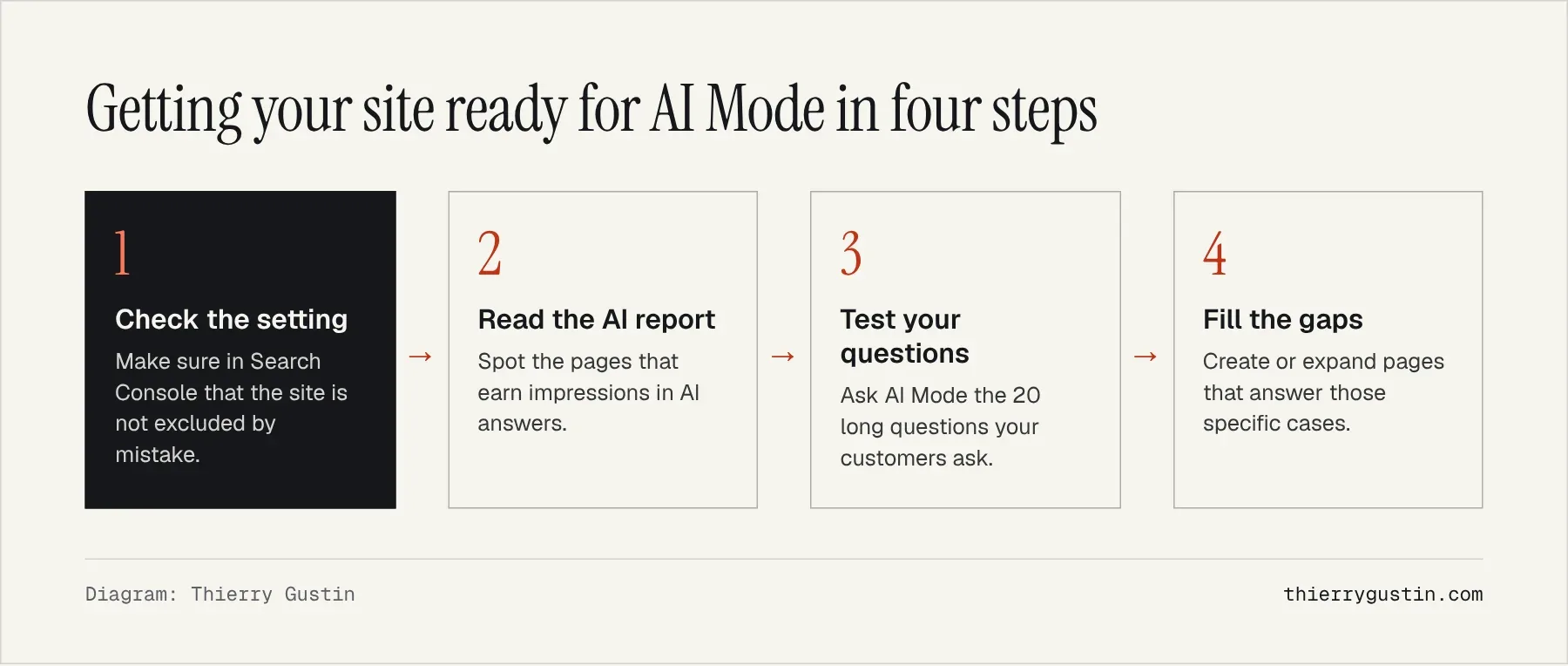
Test by hand. Write down around twenty long questions your customers really ask, on the phone or by email, and put them to AI Mode. Look at who gets cited, which pages, and what angle the answer takes. It is the most revealing diagnosis I know of, and it costs nothing.
Work on the pages that convert. Conversational questions often lead to a comparison or a decision. A service page that explains who it is for, at what price and with what limits stands a better chance of being picked up than a generic article.
Track the trend. Every month, compare the AI impressions in Search Console with your contact requests. If impressions are rising and inquiries are too, you are heading in the right direction, even if clicks are falling.
Frequently asked questions
Is Google AI Mode free in France?
Yes. Since July 22, 2026, AI Mode has been available for free in France, on desktop, on mobile and in the Google app for Android and iOS. It appears in a dedicated tab next to Images, News and Videos, and you can also reach it from an AI Overview by asking a follow-up question.
How do I stop my site from appearing in Google AI Mode?
Google offers a Search Console setting that excludes the site from AI Overviews, AI Mode and AI features in Discover. It has been open to all sites since August 31, 2026. An excluded site no longer receives impressions or traffic from these features, with no effect on its traditional ranking according to Google.
Does opting out of AI Mode hurt Google rankings?
According to Google, no: the setting is not used as a ranking signal for traditional results. However, the site loses all visibility in AI-generated answers. For most small businesses, that lost opportunity outweighs the benefit, unless the business model relies on people reading the content itself.
Does AI Mode use the same ranking as regular Google Search?
Google explains that AI Mode breaks the question into subtopics and runs several searches in parallel across its index, then writes a summary with links. A site that ranks well for those sub-questions therefore stands a better chance of being cited. There is no special markup to get in.
Sources
- Google France, Sébastien Missoffe, launch of AI Overviews and AI Mode in France (July 22, 2026)
- Blog du Modérateur, “Google déploie AI Overviews et AI Mode en France” (July 2026)
- Google, Sundar Pichai's remarks on Alphabet's Q2 2026 earnings (July 22, 2026)
- SparkToro, Rand Fishkin, zero-click searches in the United States, January to April 2026 (June 2026)
- Ahrefs, impact of AI Overviews on 963 French domains (September 16, 2026)
- Google, “New opportunities, control and insights for website owners” (June 3, 2026, updated August 31, 2026)
- Google Search Central, performance reports for generative AI features (June 3, 2026)
- Google Search Central, optimization guide for generative AI features (May 2026)
Read next

My Vision of SEO and GEO for 2027: Seven Theses and an Action Plan
SEO in 2027: my vision of SEO and GEO in seven sourced theses, the 2026–2027 timeline and the action plan small businesses should start right now.