GPT-5.5, Claude Opus 4.7, Muse Spark: What April 2026 Changed for Small Businesses
 By Thierry Gustin
Updated
6 min read
Contents
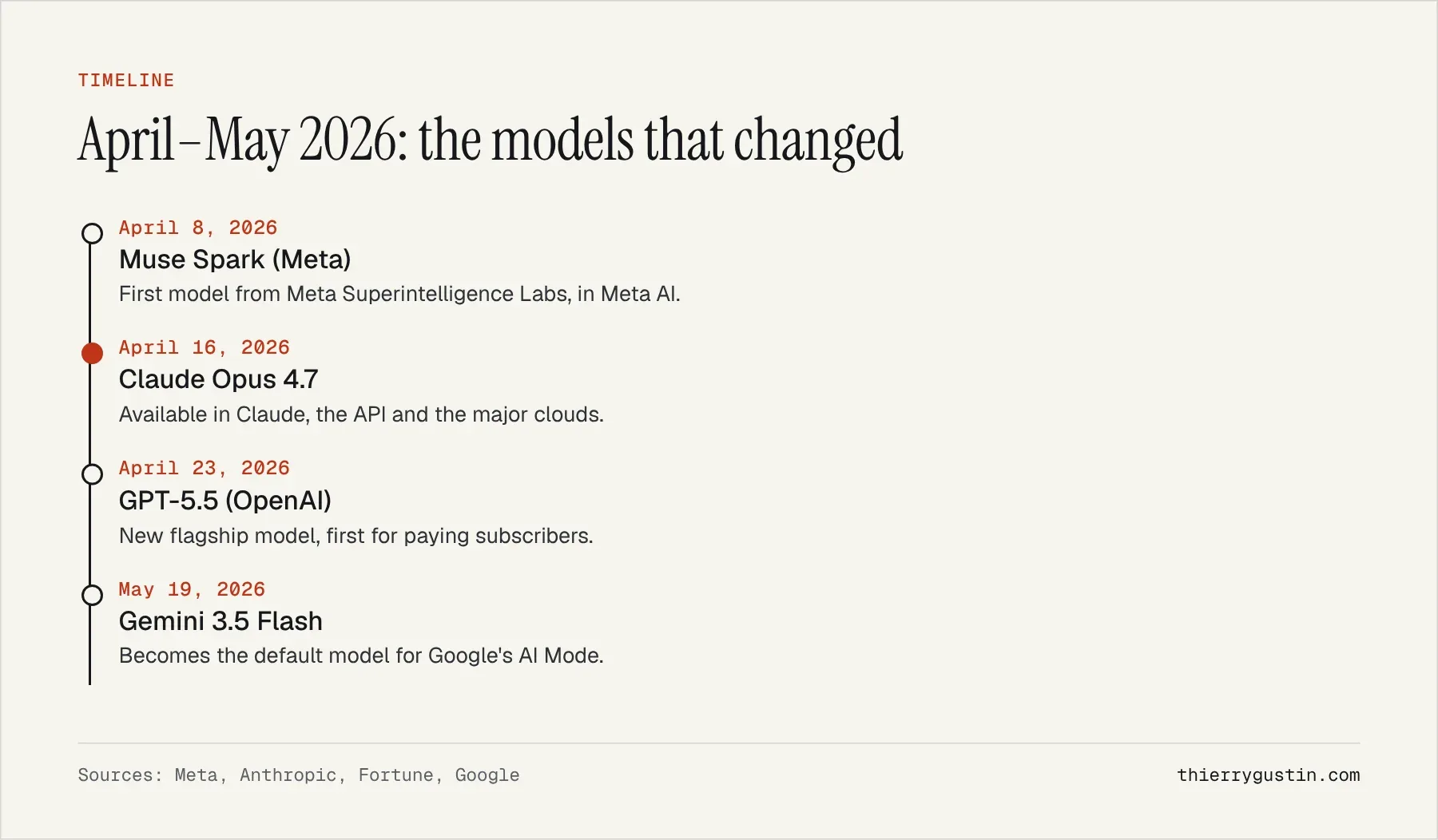
If you're looking up “new AI models April 2026”, the answer comes down to three names released in three weeks: Meta's Muse Spark on April 8[1], Anthropic's Claude Opus 4.7 on April 16[2] and OpenAI's GPT-5.5 on April 23[3]. For a small business, the new AI models of April 2026 mainly change two things: the cost of producing content and the way you write your prompts, and the number of assistants in which your brand needs to be visible.
Looking back from November 2026, we can now separate the announcements from the changes that had real effects. I won't compare benchmark scores, which are of little interest to a business owner. I'm looking at what these releases mean for a website, a budget and a visibility strategy.
What changed with Claude Opus 4.7?
Claude Opus 4.7 has been available since April 16, 2026 in Claude's products, the API, Amazon Bedrock, Google Cloud's Vertex AI and Microsoft Foundry[2]. The list price hasn't moved: $5 per million input tokens and $25 per million output tokens, the same as Opus 4.6.
The detail that matters is further down the announcement: the new tokenizer can turn the same text into more tokens, roughly 1.0 to 1.35 times as many depending on the type of content[2]. An identical unit price can therefore hide a higher bill. It's the kind of line a marketing manager never reads, and that their accountant discovers three months later.
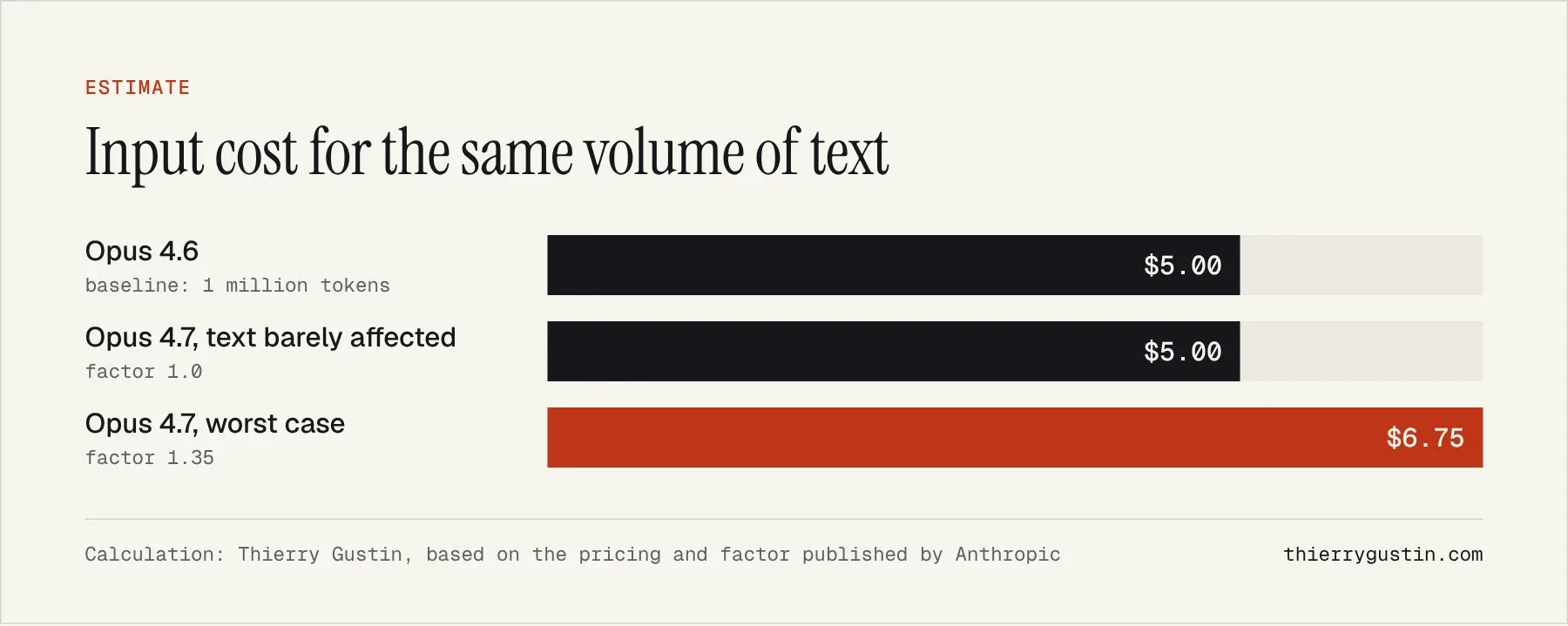
This calculation is an estimate: the real factor depends on your texts, and you need to measure it on your own workloads. But it gives the order of magnitude, up to 35% more on the input side, for anyone processing large volumes of documents.
Two other changes matter directly to small businesses. Opus 4.7 accepts images up to 2,576 pixels on the long edge, about 3.75 megapixels, more than three times the resolution of previous Claude models[2]. It reads a screenshot, a scanned table or a chart better. And Anthropic warns that the model follows instructions much more literally, to the point that prompts written for earlier versions may need to be readjusted[2].
GPT-5.5 and Muse Spark: what's the difference for a business?
GPT-5.5 arrived on April 23, 2026 for paying ChatGPT subscribers, about six weeks after GPT-5.4[3]. OpenAI's president, Greg Brockman, presents it as faster and more token-efficient than its predecessor. I wasn't able to consult OpenAI's own announcement, which was inaccessible from my environment, so I'm sticking to what Fortune reported.
Muse Spark is a different kind of thing. It's the first model from Meta Superintelligence Labs, designed to be small and fast, and it powers the Meta AI app and meta.ai, starting in the United States[1]. Meta announced a gradual rollout to WhatsApp, Instagram, Facebook and Messenger, with no precise timeline, and an API reserved for a few partners for now.
What interests me about Muse Spark isn't the model, it's the Shopping mode. It searches Facebook Marketplace listings near the user and products from across the web, with a map and filters by price, style or distance[1]. Users can also mention a brand to see its public content and products. For a retailer, that's a new search engine that partly relies on its social media posts.
| Model | Date | Where you'll find it | What matters for a small business |
|---|---|---|---|
| Muse Spark (Meta) | April 8, 2026 | Meta AI, then Meta apps | Product and brand search within the Meta ecosystem |
| Claude Opus 4.7 (Anthropic) | April 16, 2026 | Claude, API, Bedrock, Vertex AI, Foundry | Same list price, up to 1.35 times more tokens |
| GPT-5.5 (OpenAI) | April 23, 2026 | ChatGPT (paying subscribers) | Flagship model of the most widely used assistant |
Do these models change how people search for information?
Indirectly, yes. Every assistant becomes a place where your customers ask questions and get recommendations. In the United States, a Pew survey conducted in February 2026 found that 49% of adults have used a chatbot such as ChatGPT, Gemini or Copilot, and 66% of 18- to 29-year-olds[4]. Half of the population still doesn't use one, which puts all the talk about the end of Google into perspective.
Because Google made the same move inside its own search engine. In May 2026, it announced that AI Mode had passed one billion monthly users and was switching to Gemini 3.5 Flash by default[5]. The model change that mattered most for your traffic may not have happened in April at OpenAI or Anthropic, but in May, at Google.
My take: don't chase every new model
I see a lot of businesses switching tools with every announcement. It's a waste of time. A new model doesn't change what gets a brand cited: accurate information, consistent from one site to another, easy to find and to verify. These fundamentals, which I cover in my guide to getting cited by ChatGPT, Gemini and Perplexity, hold true from one generation to the next.
Two things, however, deserve real attention. First, your costs: if you produce content or run customer service through an API, measure the number of tokens before and after every model change. Second, your prompts: a model that follows instructions more literally exposes the vagueness in your prompt templates. It's a chance to rewrite them properly, with a clear tone, clear sources and clear limits.
One last word of caution: in April 2026, Muse Spark and its shopping features launched in the United States first. For a small business in France or Spain, it's something to keep an eye on, not a budget priority. Better to first strengthen your presence where customers are already searching.
What should you do in practice?
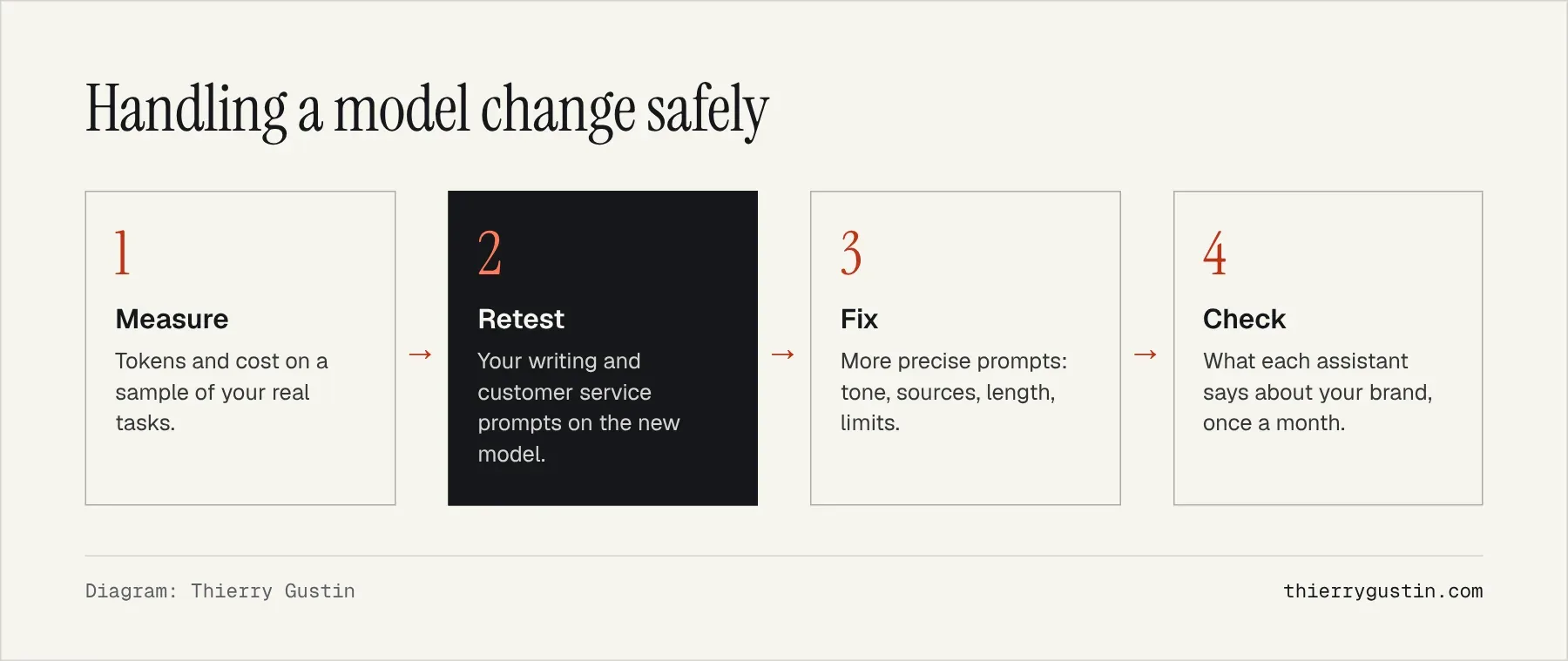
The last step is the most neglected. Every month, ask ChatGPT, Claude, Gemini and Meta AI the same questions: “which provider would you recommend for…”, “what do you know about [your company]”. Note the errors and the gaps. That's exactly what our open-source tool Vigie does, and it's what I teach teams to do in-house in the GEO training.
Frequently asked questions
Which new AI models were released in April 2026?
Three major models: Meta's Muse Spark on April 8, the first model from Meta Superintelligence Labs; Anthropic's Claude Opus 4.7 on April 16, available in Claude, the API and the main clouds; and OpenAI's GPT-5.5 on April 23, first for paying ChatGPT subscribers. Gemini 3.5 Flash became the model behind Google's AI Mode in May.
Is Claude Opus 4.7 more expensive than Opus 4.6?
The price per million tokens is the same: $5 for input and $25 for output. But according to Anthropic, the new tokenizer can produce 1.0 to 1.35 times more tokens for the same text. The real cost can therefore rise by up to about 35% for some content. Measure it on your own tasks.
Do I need to adapt my website to every new AI model?
No. Assistants rely on public information: your website, your listings, the sites that talk about you. Content that is accurate, up to date, consistent and accessible to crawlers serves every model at once. What changes from one model to the next is mainly the cost and the way you write your internal prompts.
Is Muse Spark available outside the US, for example in France or Spain?
In April 2026, Meta launched it in the Meta AI app and on meta.ai starting with the United States, and announced an expansion to other countries without naming them. Its arrival in WhatsApp, Instagram, Facebook and Messenger was announced with no precise timeline. Check availability in your country before spending budget on it.
Sources
- Meta Newsroom, introducing Muse Spark (April 8, 2026, updated May 12, 2026)
- Anthropic, Claude Opus 4.7 announcement (April 16, 2026)
- Fortune, OpenAI releases GPT-5.5 (April 23, 2026)
- Pew Research Center, “Americans and AI 2026: Chatbots, Smart Devices and Views on Impact” (June 17, 2026)
- Google, “A new era for AI Search” (I/O, May 19, 2026)
Read next
AI Mode and AI Overviews Don’t Cite the Same Sources: Measure Them Separately
AI Mode vs AI Overviews: only 13.7% of cited URLs in common, per Ahrefs. What the study says, what has changed since, and how to measure both.