The March 2026 Core Update Finished on April 8: How to Read Your Numbers Without Panicking
 By Thierry Gustin
Updated
6 min read
Contents
The March 2026 core update began on March 27, and Google declared it complete on April 8, 2026, after about twelve days of rollout[1]. To find out whether it affected your site, Google recommends waiting at least one week after the rollout ends, then comparing a full week with the week before the launch[2]. Any analysis done during the rollout mixes noise with signal.
Looking back from November 2026, I'm revisiting this update for a simple reason: it's the one I've seen small businesses misread the most this year. Between the Easter holidays, spam reports that could now lead to penalties and the expected arrival of AI in search, many April drops were blamed on the wrong cause. Here is the method for reading your numbers, and it applies to every core update.
When did the March 2026 core update take place?
Google's official dashboard gives the exact dates. The launch was announced on March 27, 2026 at 2:14 a.m. Pacific Time, with this caveat: the rollout “may take up to 2 weeks”. On April 8, Google stated that the rollout was complete[1]. There was no core update in April: the next one started on May 21[3].
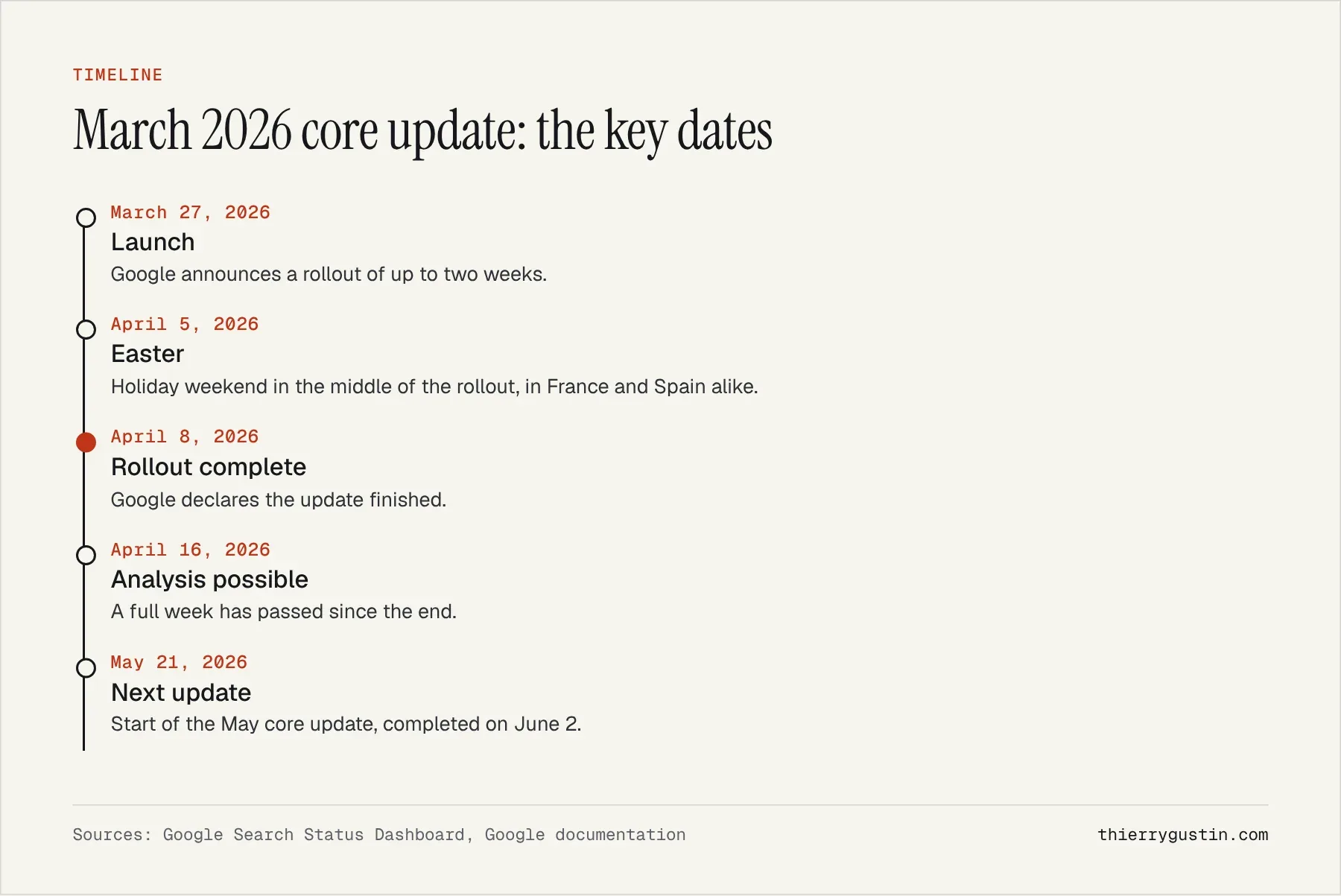
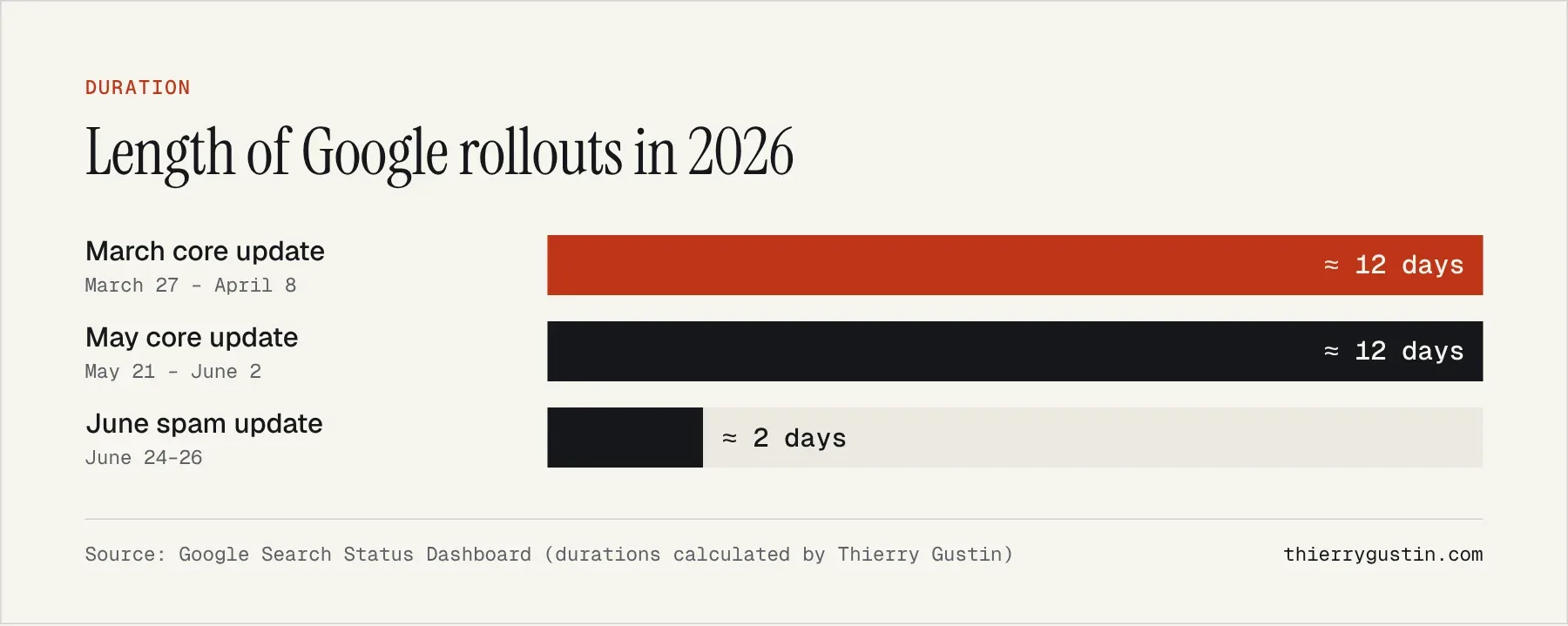
These dates are the first thing to record in your analytics tool. A core update doesn't apply all at once: for about ten days, rankings fluctuate. A drop observed on April 1 tells you nothing about the final state. By comparison, the June spam update lasted only two days[4].
How do you analyze your traffic after a core update?
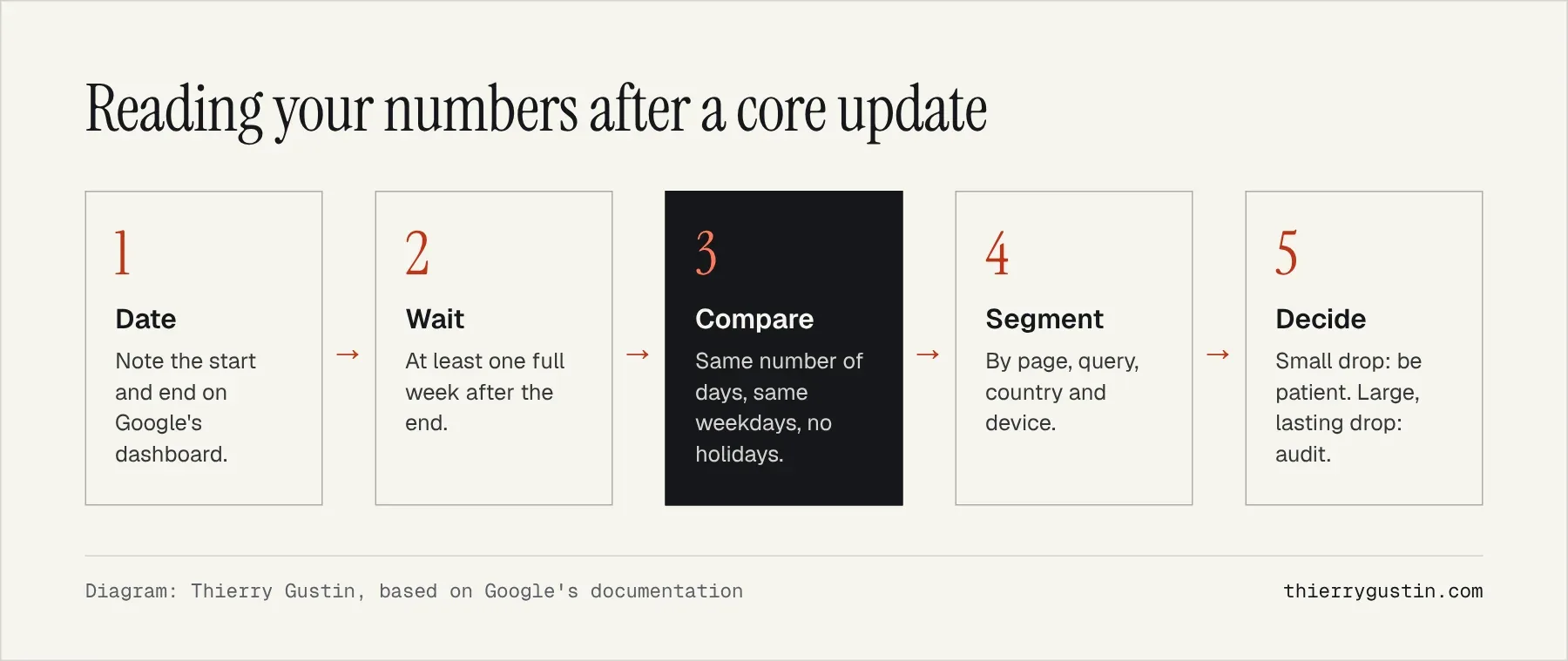
Google gives a precise method in its documentation. Wait at least one full week after the rollout has finished before analyzing your site in Search Console. Then compare that week with a week before the rollout started[2].
Applied to March 2026, that means comparing Friday, March 20 to Thursday, March 26 (the week just before the launch) with, for example, Friday, April 17 to Thursday, April 23. I recommend keeping the same days of the week, because most small business sites get very different traffic on a Monday and a Saturday. And this window has one decisive advantage: it leaves Easter out.
In Search Console, then break the data down three ways: by page, by query and by country. A drop concentrated on a few blog posts has nothing in common with a drop spread across the whole site. A drop limited to Spain doesn't have the same cause as a drop in France.
Small or large drop: what does Google say?
This is the most useful part of the documentation, and the most ignored. For a small drop, Google says there's no need to take radical action. For a large drop, especially if it lasts and affects the whole site, it recommends a more thorough assessment[2].
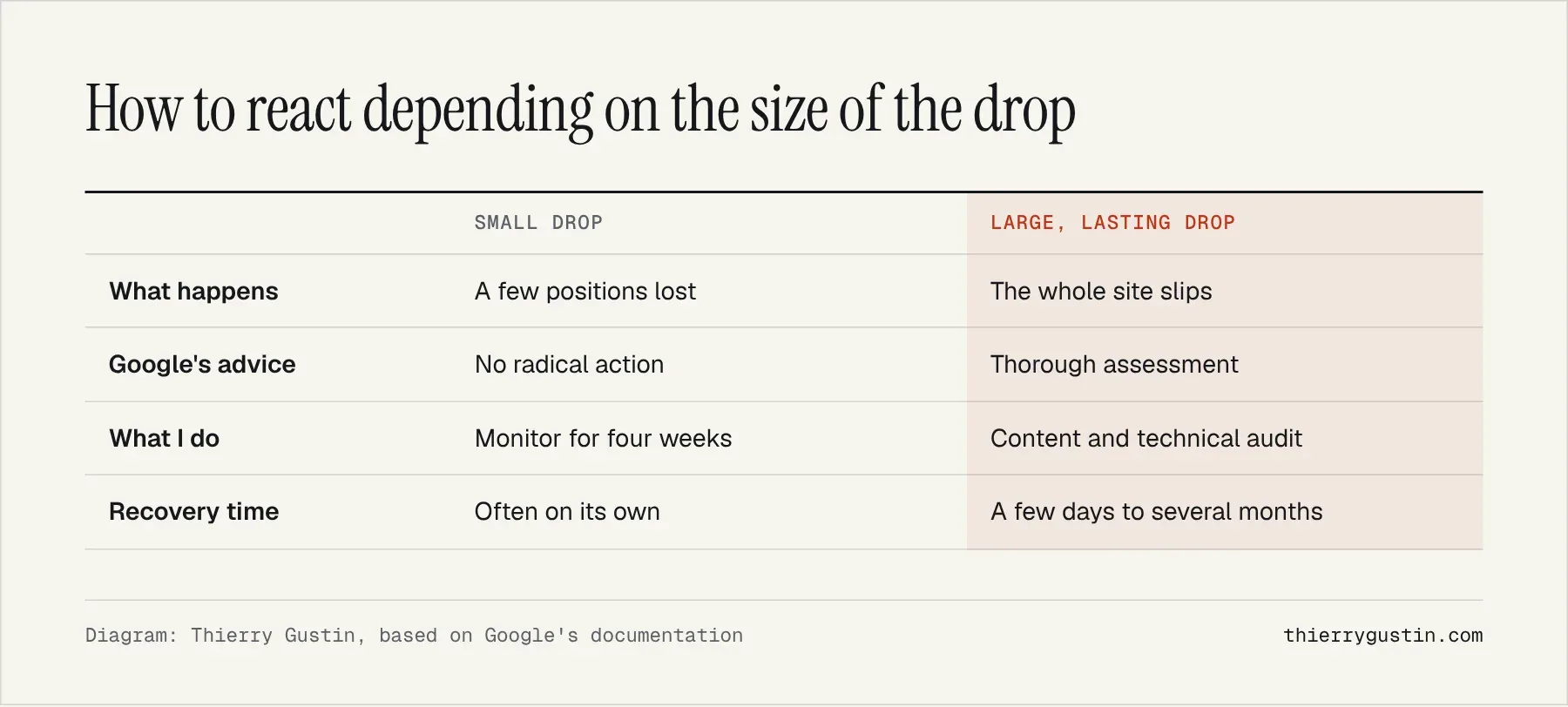
On recovery, Google remains cautious: some changes take effect within a few days, but it can take several months for its systems to confirm a lasting improvement. If nothing has changed after a few months, it's often the next core update that picks it up[2]. For a site hit in March, that meant the one running from May 21 to June 2, which I analyze in my article on the May 2026 core update.
What other causes should you check before blaming Google?
Easter fell on April 5, 2026, in the middle of the rollout. For a tourism, restaurant or B2B services site, Holy Week (Semana Santa) in Spain and the Easter weekend in France shift demand far more than an update does. A poorly chosen comparison can make a seasonal dip look like a penalty.
Second lead: manual penalties. Since April 14, 2026, Google may use spam reports to take manual actions[5], and back button hijacking became an explicit violation on April 13. Check the Manual actions report in Search Console; I explain the rest in my article on back button hijacking.
Third lead, depending on your country: AI Overviews. In Spain, they've been live since March 26, 2025[6], so their effect blends with that of the core update. In France, they only arrived on July 22, 2026[7]: a French drop in April cannot be attributed to them. It's a good example of how the national context changes the diagnosis.
My take
Most of the small businesses I work with aren't “hit” by a core update. They experience a variation of a few percent that they spot in the middle of the rollout, and then they react: rewriting pages, deleting content, switching agencies. That's often worse than the drop itself.
My advice is to treat a core update as a health check, not an emergency. If your most useful pages are losing ground to competitors who answer the question better, the problem existed before the update; the update simply revealed it. The work is then editorial and is measured in months, not days.
At the end of April, Google also made its “preferred sources” available in every search language, with translated buttons to download[5]. This feature lets users favor a site in Top Stories. It mainly concerns sites that publish news, but it illustrates an underlying trend: your readers' loyalty becomes an asset against algorithm fluctuations.
What should you do in practice?
- Add an annotation in your analytics tool for every update confirmed by Google, with its start and end dates.
- Draw no conclusions until a full week after the rollout has ended.
- Compare identical weeks, excluding public holidays, then break down by page, query and country.
- If you see a large, lasting drop, have your content and technical setup audited before changing anything.
On the technical side, our open-source crawler Arachnide lets you quickly check that no indexing or redirect errors crept in during the same period. It's the cheapest check, and it rules out a common cause.
Frequently asked questions
What are the dates of the March 2026 core update?
Google launched the March 2026 core update on March 27, 2026 and declared it complete on April 8, 2026, about twelve days of rollout. There was no core update in April. The next core update ran from May 21 to June 2, 2026, according to Google's official dashboard.
How long should you wait before analyzing traffic after a core update?
Google recommends waiting at least one full week after the rollout ends, then comparing that week with a week before the update started. For March 2026, a serious analysis was therefore only possible from around April 16, while avoiding the Easter weekend.
How do you recover from a Google core update?
There's no quick technical fix. Google says some changes take effect within a few days, but confirming a lasting improvement can take several months, often until the next core update. The work focuses on the usefulness and reliability of your content, not on one-off tweaks.
Was a traffic drop in April 2026 necessarily caused by the core update?
No. Check seasonality (Easter fell on April 5), the Manual actions report in Search Console and, for Spain, the effect of AI Overviews, live there since March 2025. In France, AI Overviews only arrived on July 22, 2026, so they don't explain an April drop there.
Sources
- Google Search Status Dashboard, March 2026 core update (March 27 – April 8, 2026)
- Google Search Central, documentation on core updates
- Google Search Status Dashboard, May 2026 core update (May 21 – June 2, 2026)
- Google Search Status Dashboard, June 2026 spam update (June 24–26, 2026)
- Google Search Central, documentation updates log (entries for April 14 and 30, 2026)
- PPC Land, European rollout of AI Overviews (March 2025)
- Google France, launch of AI Overviews and AI Mode in France (July 22, 2026)
Read next
My Vision of SEO and GEO for 2027: Seven Theses and an Action Plan
SEO in 2027: my vision of SEO and GEO in seven sourced theses, the 2026–2027 timeline and the action plan small businesses should start right now.