May 2026, the Month Google Cleaned House: FAQ Rich Results Gone and a Core Update
 By Thierry Gustin
Updated
6 min read
Contents
Google's May 2026 core update rolled out from May 21 to June 2, two weeks after FAQ rich results disappeared, a change effective since May 7[1][3]. If your traffic moved in May, you therefore need to separate two causes: the loss of a display feature (the expandable questions under your results) and a broad reassessment of rankings. My advice: keep your FAQs visible on the page, don't rush to remove the markup, and read your numbers over carefully chosen periods.
For a small business, these two changes so close together muddy the analysis. Many sites had added FAQPage markup because they'd been promised more space in the results; others saw their rankings move at the end of May without having changed anything. With the hindsight of November, here's what really happened and what I take away from it.
Why did FAQs disappear from Google results?
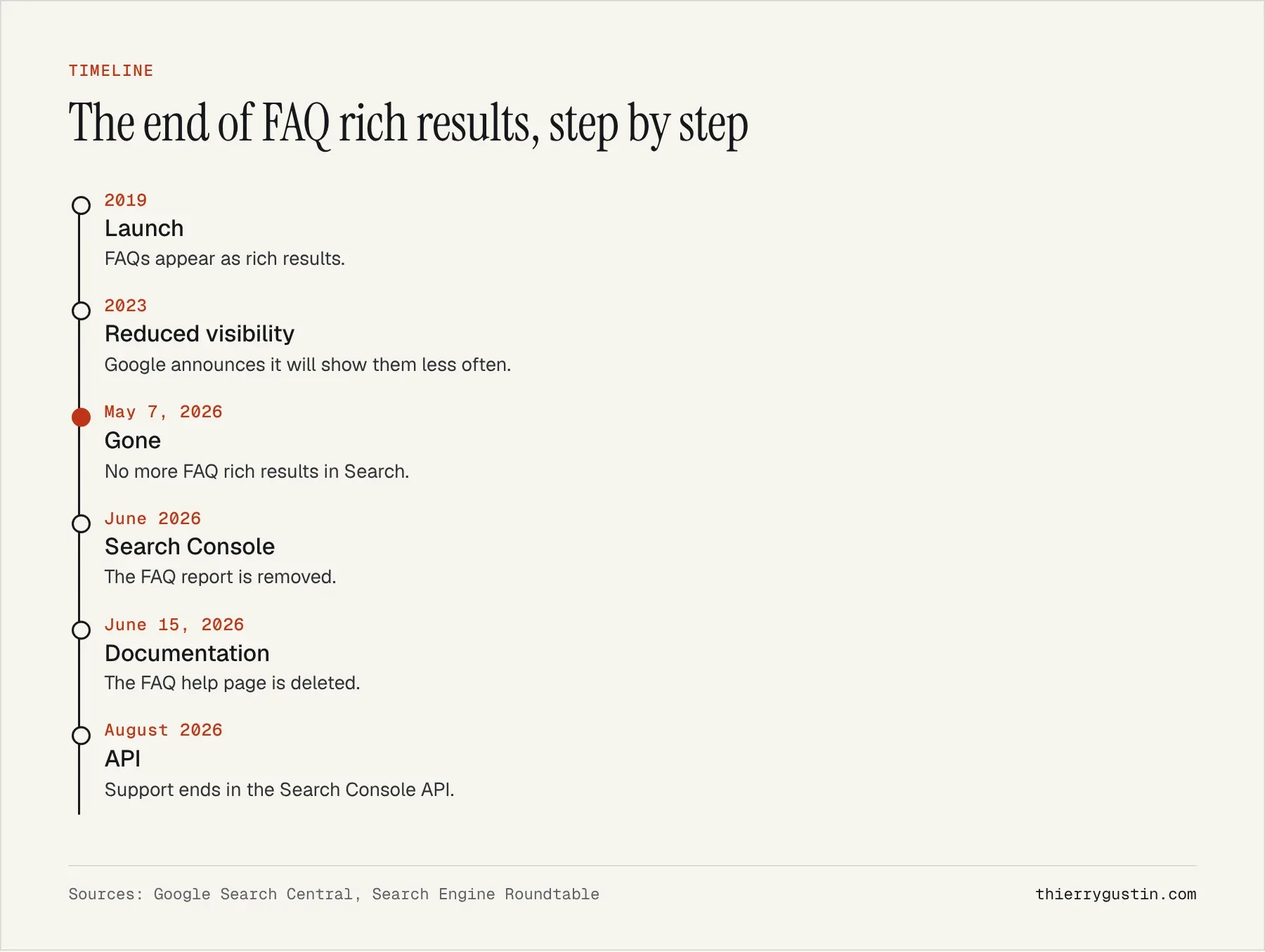
On May 8, Google added a deprecation notice to its documentation: the feature “will no longer appear in Google Search starting May 7, 2026”[1]. The removal then proceeded methodically: the FAQ report was dropped from Search Console in June, the documentation was removed on June 15, and support in the Search Console API ended in August[1][2].
Google didn't offer a lengthy justification, but the decision extends a long-standing trend: launched in 2019, FAQ rich results had already been shown far less often since 2023[2]. According to John Mueller, “for the most part, this doesn't change anything in Search,” and markup on sites that weren't eligible was already being ignored[2].
Should you remove FAQPage markup from your site?
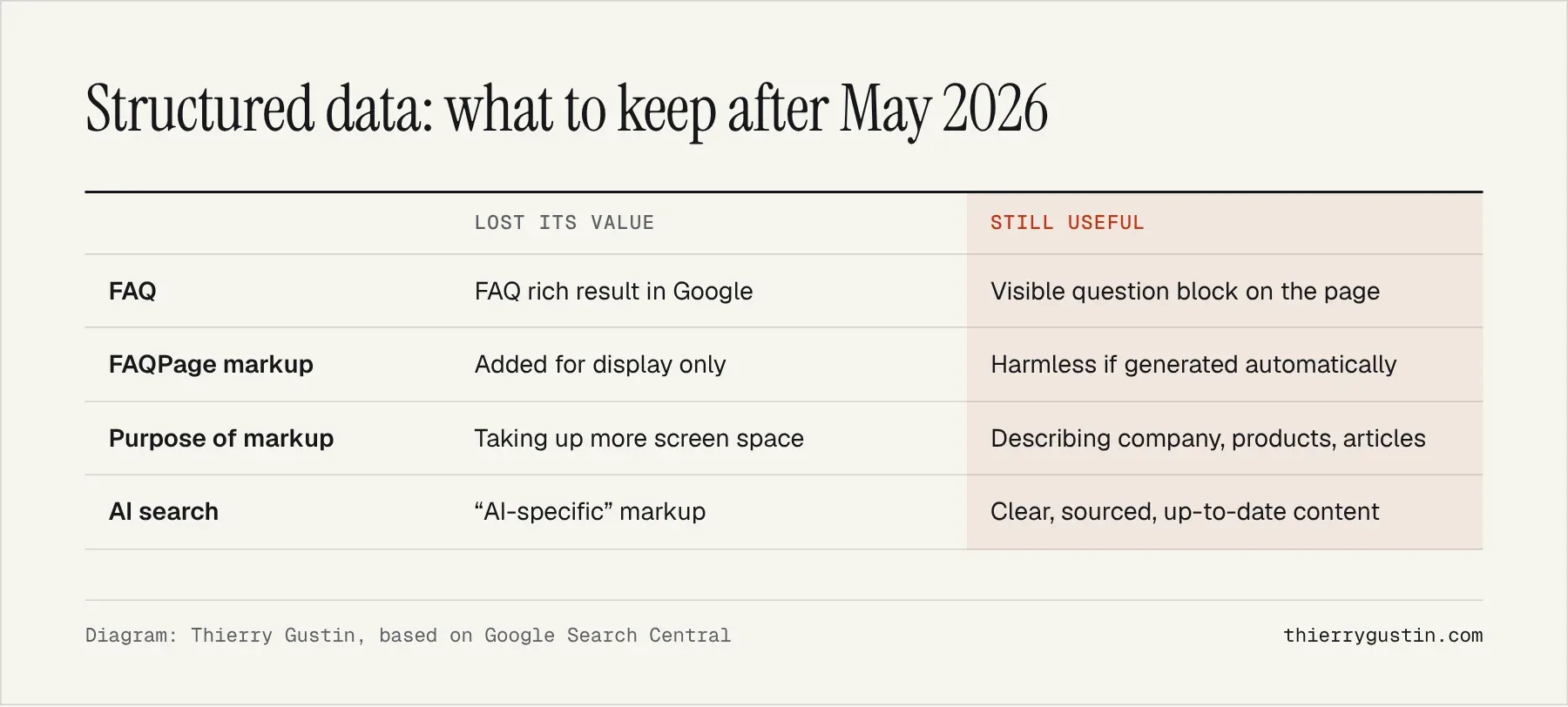
Not urgently. Mueller summed it up simply: there's no need to change anything, but if you added this markup for Search, you can remove it if you wish[2]. The markup doesn't hurt you; it just no longer has any visible effect in Google.
My recommendation is more nuanced than “delete everything.” The visible question-and-answer block on the page keeps its value: it answers your customers' questions in a few lines, a format that's easy to pick up for a reader in a hurry as well as for an AI assistant. What's gone is the display bonus. If the markup is generated automatically by your CMS or a plugin, leave it; if it's maintained by hand and prone to errors, remove it at your next redesign.
Also remember what Google wrote on May 15 in its AI guide: no special schema.org markup is needed for generative search, even though structured data is still recommended for rich results[4]. I analyzed that guide in a dedicated article, and I detail the markup types I keep in the structured data section of my GEO guide.
What did the May 2026 core update change?
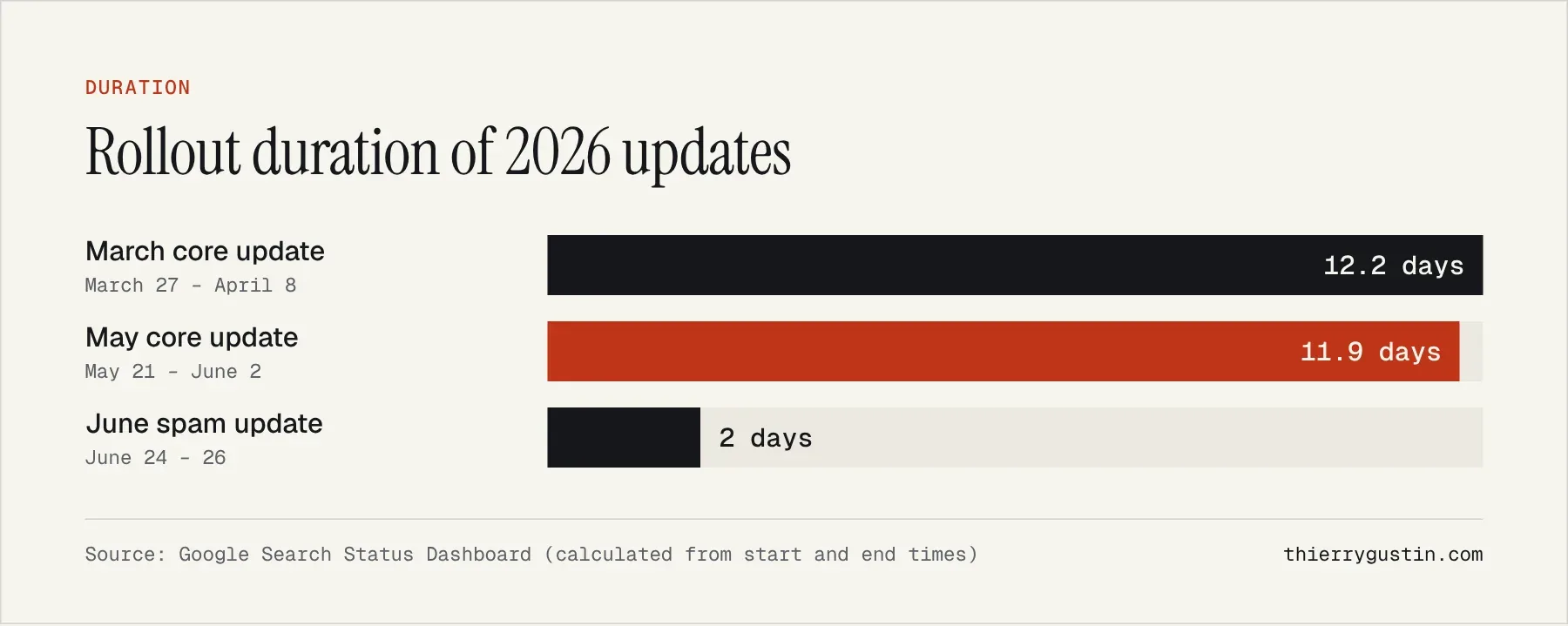
Google's status dashboard shows a start on May 21, 2026 at 8:40 a.m. Pacific time, with the usual warning that the rollout “may take up to 2 weeks.” It finished on June 2 at 5:40 a.m.[3]. As with any core update, Google didn't detail what changed: it's a broad reassessment, not a targeted penalty against a site.
It was the second core update of the year, after the March one, which rolled out from March 27 to April 8[5]. Both lasted almost exactly twelve days. There were none in April, June or July; a spam update did, however, follow from June 24 to 26[6], which I cover in the June technical checklist.
How should you read your May and June 2026 traffic?
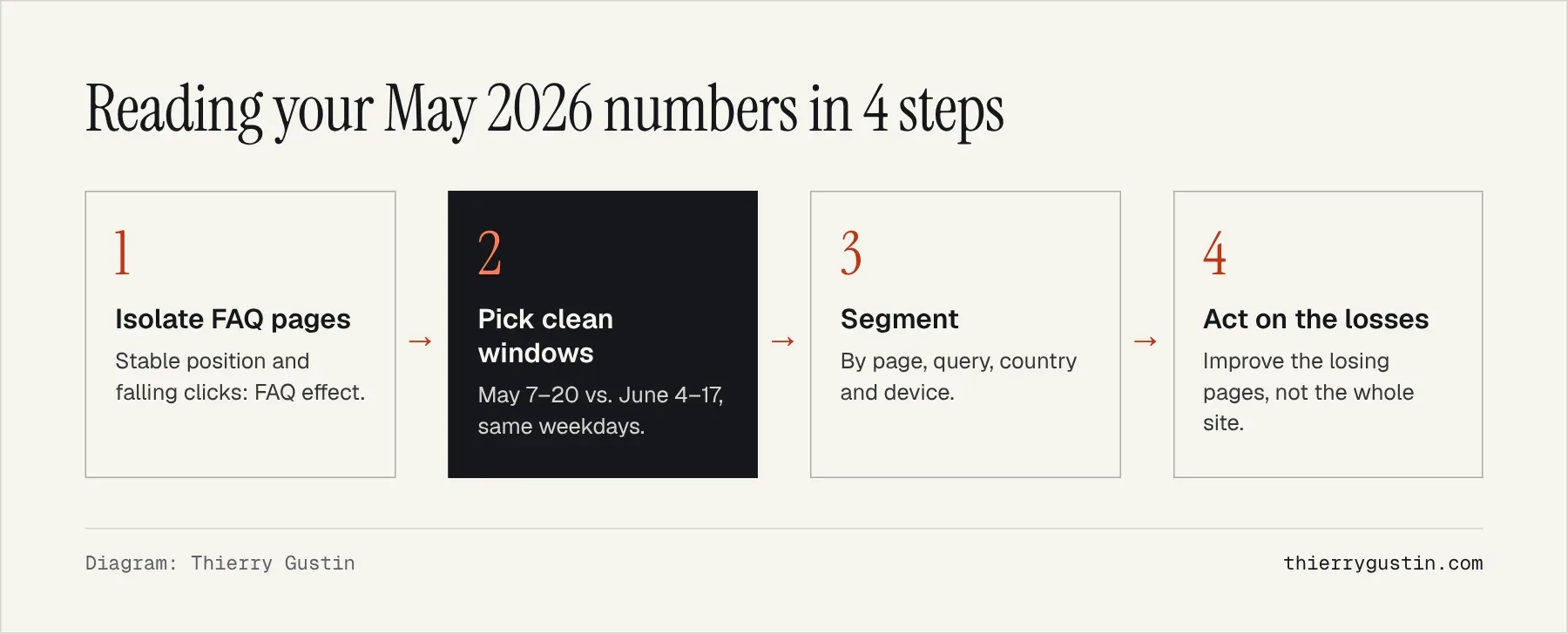
The classic trap is blaming the core update for a drop that started two weeks earlier. If pages that used to show FAQ rich results lost clicks from May 7 without losing rankings, it's the display that changed, not your ranking. In Search Console, a stable average position with a falling click-through rate is the signature of the end of FAQs.
To isolate the effect of the core update, I compare two fourteen-day windows, Thursday to Wednesday: May 7 to 20, already without FAQ rich results, and June 4 to 17, after the rollout ended and before the spam update. This neutralizes the spring's two other changes. Then you drill down to the page and query level: an overall average almost always hides winners and losers.
My take: a fairly healthy clean-up
May 2026 got rid of a trick and restated the obvious. The trick was FAQ markup added purely to take up more screen space. The obvious point is that a core update favors the pages that answer best, not those that stack up tags. Both go in the same direction as the AI guide published that same month.
A quieter signal deserves attention: on May 27, Google started rolling out preferred sources to AI Overviews and AI Mode[1]. For a site that publishes regularly, the loyalty of readers who explicitly choose you becomes a lever; for a brochure site, the effect will remain marginal.
Finally, I warn against knee-jerk reactions. Deleting or rewriting pages during the rollout skews every measurement. Wait for the official end, then two to three weeks of stable data, as I explain in my method for reading a core update.
What should you actually do?
- Keep your FAQ blocks visible if they answer real customer questions; remove the ones that only existed for the markup.
- Leave automatic FAQPage markup in place without spending time on it; stop creating it to gain display space.
- Compare May 7–20 with June 4–17 to measure the core update, page by page.
- For each page that dropped, look at who overtook you and what their page offers that yours doesn't: data, examples, updates.
These checks take half a day on a small business website. Above all, they keep you from fixing the wrong problem: reworking an entire site because a display feature disappeared, or touching the markup when it's the content that slipped.
Frequently asked questions
When did the May 2026 core update finish?
According to Google's official status dashboard, the May 2026 core update started on May 21 at 8:40 a.m. and finished on June 2 at 5:40 a.m., Pacific time, so just under twelve days. Google had announced a rollout that could take up to two weeks. No other core update took place before the summer.
Can FAQPage markup hurt my site?
No. Google simply stopped showing FAQ rich results on May 7, 2026. John Mueller said there was nothing to change, and that you could remove the markup if you had added it only for Search. It no longer has any visible effect, but it doesn't harm your rankings.
Why did my click-through rate drop in early May 2026?
If the drop starts around May 7 and affects pages that used to show expandable questions, the most likely cause is the end of FAQ rich results: your listings take up less space. Check in Search Console that your average position stayed stable. If your rankings dropped too, look at the core update instead.
Are on-page FAQs still useful in 2026?
Yes, if they answer real questions. A short, precise answer helps visitors decide, and it's an easy format for answer engines to cite. What has lost its value is the FAQ written only to get a rich display in Google, with questions nobody actually asks.
Sources
- Google Search Central, documentation updates log (May 8, May 27 and June 15, 2026)
- Search Engine Roundtable, “Google drops FAQ rich results” (May 2026)
- Google Search Status Dashboard, May 2026 core update
- Google Search Central, guide to optimizing for generative AI features (May 2026)
- Google Search Status Dashboard, March 2026 core update
- Google Search Status Dashboard, June 2026 spam update
Read next
My Vision of SEO and GEO for 2027: Seven Theses and an Action Plan
SEO in 2027: my vision of SEO and GEO in seven sourced theses, the 2026–2027 timeline and the action plan small businesses should start right now.