April 2026: Why Being Cited in AI Overviews Matters More Than Ranking First
 By Thierry Gustin
Updated
6 min read
Contents
In April 2026, a Seer Interactive study produced a figure worth remembering about AI Overview citations: on informational queries, a brand cited in Google's AI Overviews gets an organic click-through rate of 2.07%, compared with 0.94% when it isn't cited[1]. Being the source the AI mentions pays off more than many expected, and ranking position alone no longer guarantees visits.
Looking back from November 2026, this study, published on April 24, deserves a second read. At the time, AI Overviews were not yet available in France but had been live in Spain since March 26, 2025[4]. They arrived in France on July 22, 2026[5]. For a French small business, what once looked like an American curiosity has become a reality in its own traffic reports.
What exactly did Seer's April 2026 study measure?
Seer Interactive analyzed data from 53 brands: 5,471,127 queries and 2.43 billion organic impressions, from January 2025 to February 2026[1]. It is the third edition of a study tracked since 2025, which means we are looking at a trend rather than a snapshot.
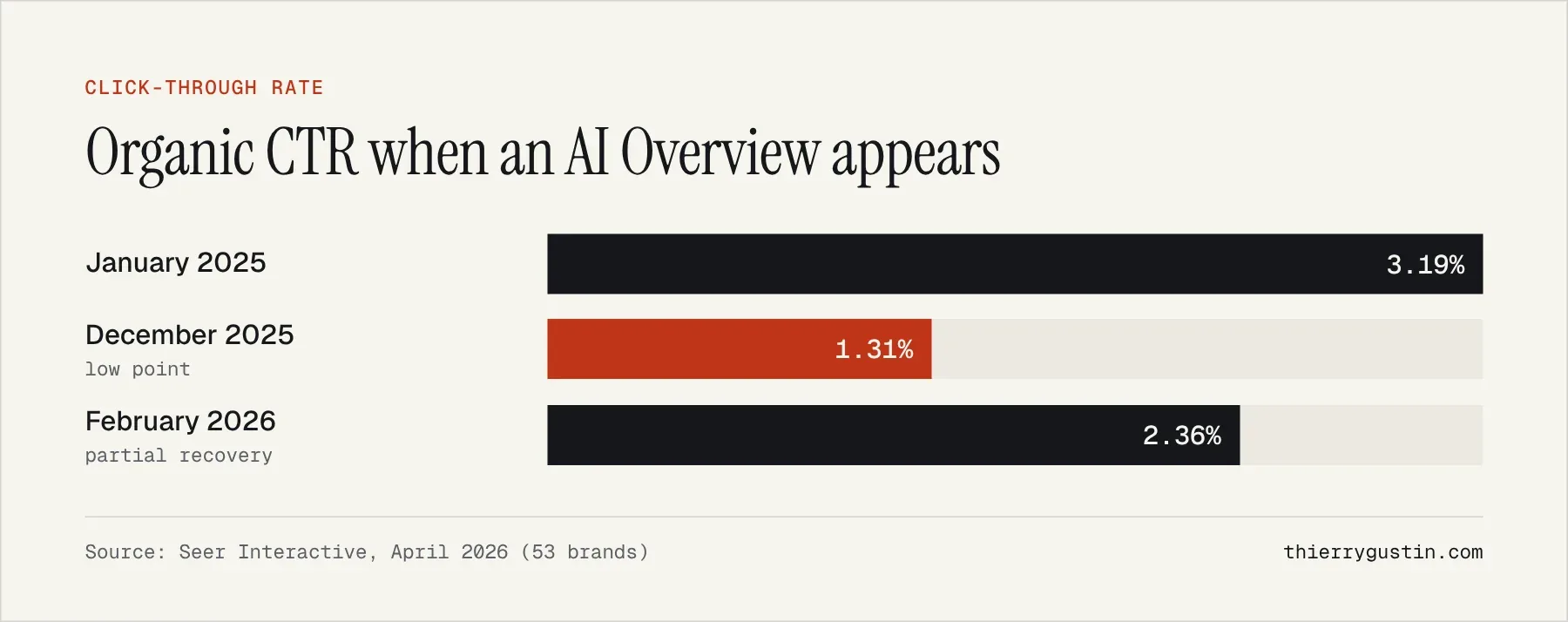
The first finding confirms what everyone had been seeing: when an AI Overview appears, organic click-through rate collapses. It went from 3.19% in January 2025 to 1.31% in December 2025. The second finding is more surprising: it climbed back to 2.36% in February 2026[1]. A partial recovery, not a return to normal.
Meanwhile, queries without an AI Overview became more valuable: their click-through rate rose from 2.75% to 3.82% over the period[1]. Traffic isn't disappearing; it's shifting toward searches where Google has no ready-made answer.
Why does a citation weigh more than your ranking?
The study's key figure concerns informational queries over 2025. Seer compares three situations: no AI Overview, an AI Overview that cites the brand, and an AI Overview that doesn't[1].
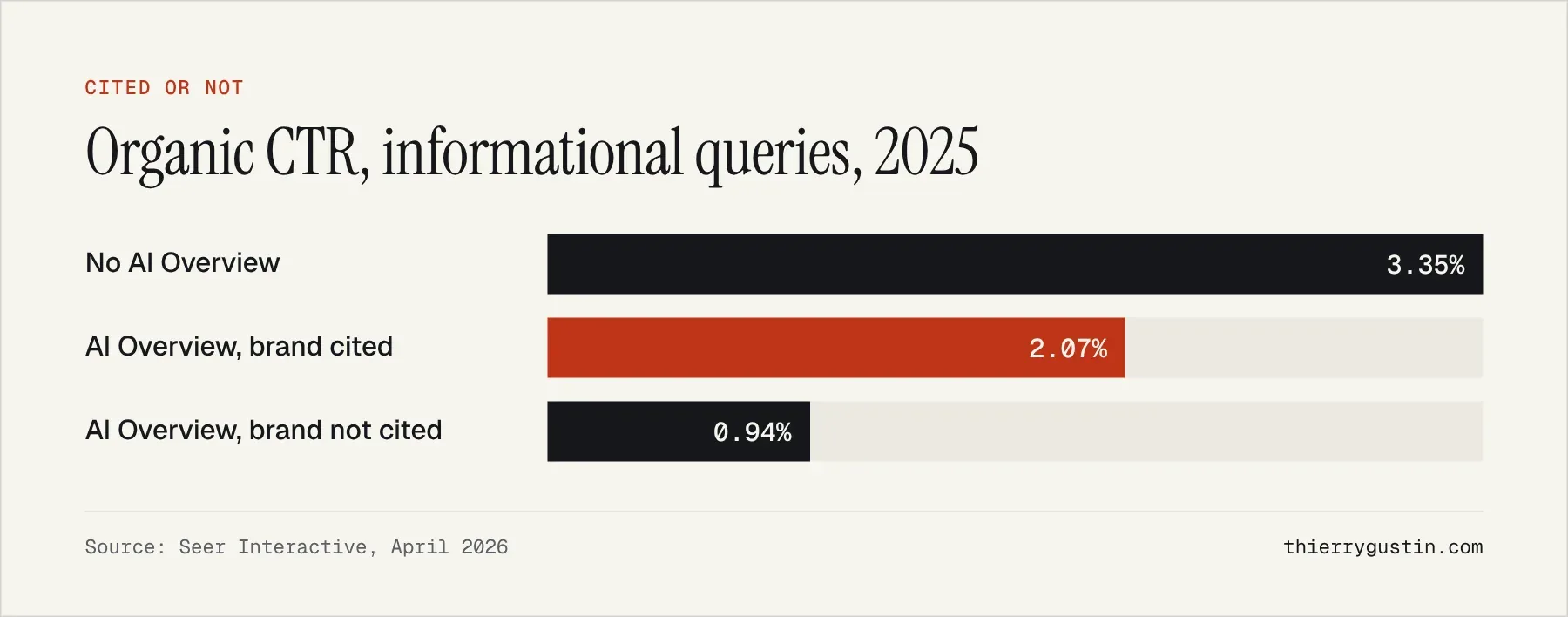
Seer expresses this gap as 120% more clicks per impression for cited brands compared with brands missing from the answer, but −38% compared with a results page with no AI Overview at all[1]. In other words, a citation doesn't fully make up for the loss. It cuts the damage roughly in half.
Put this next to Ahrefs' February 2026 study: across 300,000 keywords, the page ranking first sees its click-through rate fall by about 58% when an AI Overview appears, with a measured CTR of around 1.6% versus the 3.7% expected without one[2]. Ranking first beneath an AI summary often means ranking first below the fold. Being cited means appearing in the block people actually read.
The Pew Research Center had already measured the other side of the problem in 2025: users clicked a traditional result 8% of the time when an AI summary appeared, versus 15% without one, and clicked a link inside the summary only 1% of the time[3]. A citation therefore brings visibility and credibility first, and clicks only second.
What doesn't the study tell us?
I always read the methodology notes before the headlines. Here, they matter. Seer states that its findings are correlational and do not establish causation[1]. Cited brands may be cited because they are already strong, rather than the other way around.
Another important detail: a single account represents 47% of the impressions in the “not cited” group, with a CTR of 0.20%. Without it, that group rises to around 1.61%[1]. The gap between cited and not cited remains real, but it shrinks to a few tenths of a point. It's a solid trend, not a law of physics.
Finally, exposure varies a lot by search intent. Seer sees AI Overviews on 36% of informational queries, 8% of commercial queries and 5% of transactional queries[1]. A small business that sells online is therefore far less affected on its product pages than on its blog.
What has happened in France since then?
Ahrefs' study published on September 16, 2026 finally provided French data. Across 963 domains, comparing the 28 days before July 22 with the 9 days after, click-through rate fell by 3.4% across the whole panel, but by 23.1% for domains highly exposed to AI Overviews[6]. Health sites lost 20.4% of their CTR.
These figures confirm April's intuition: the impact depends less on your ranking than on the nature of your queries and on whether you appear in the answer. I've covered all the traffic studies in detail in my article on the impact of AI Overviews on traffic.
My take: change the goal without giving up on SEO
Here's what I've been telling clients since this study: the goal is no longer just “rank first”, it's “be the source the AI cites”. The good news is that the two goals overlap heavily. Google put it in black and white in its May 2026 guide: optimizing for generative search means optimizing for the search experience, “and thus still SEO”[7].
I'm wary, on the other hand, of offers that promise guaranteed citations through special files or paid mentions. The same guide says Google Search ignores files and markup created specifically for AI[7]. I go into this in detail in my article on Google's official May 2026 guide.
For a small business, the practical consequence is twofold. On your informational content, aim for the citation: a clear answer at the top of each section, sourced figures, a named author. On your commercial pages, which are rarely exposed, keep up the classic work on rankings and conversion, because that's where your revenue is made.
How do you actually get cited?
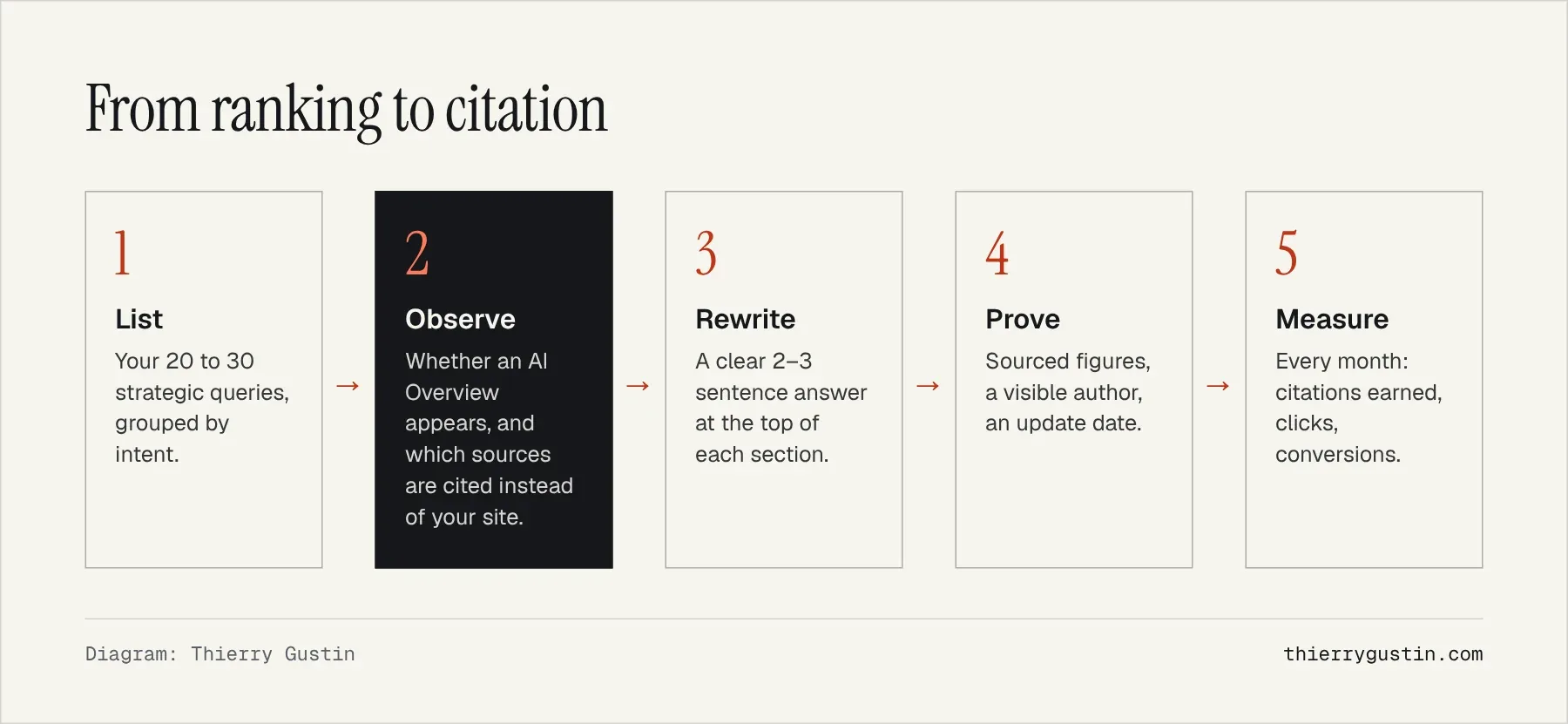
Start by observing. For each important query, note whether an AI Overview appears and which sites are cited. This manual check, repeated every month, is worth more than any aggregated metric. Our Vigie tool automates this tracking for AI assistants.
Next, rewrite to be extracted. Cited pages answer quickly and precisely, then expand. A three-paragraph introduction before getting to the point is a handicap. Add what others don't have: your own figures, your cases, your method.
Finally, change your dashboard. Track impressions and citations, not just sessions. A drop in clicks on a blog post isn't nearly as serious as a drop on a quote request page.
Frequently asked questions
What is an AI Overview citation?
It's a link to your page shown as a source in the answer Google generates at the top of the results. The AI summarizes several pages and cites some of them. Being cited gives you visibility even without a click and, according to Seer Interactive, an organic click-through rate more than twice that of uncited brands on informational queries.
Do you need to rank first to be cited in an AI Overview?
No, not necessarily. AI Overviews rely on Google's index and ranking systems, so a good ranking helps, but lower-ranked pages are regularly cited. What matters is that your page answers the question precisely, with reliable information that's easy to extract.
Does the Seer study apply outside the US, for example in France?
It covers 53 brands whose data is aggregated, and its authors present it as correlational. The trend was, however, confirmed in France by Ahrefs in September 2026: domains highly exposed to AI Overviews lost 23.1% of their click-through rate after the July 22 launch.
Are commercial pages affected by AI Overviews?
Much less. Seer sees AI Overviews on 36% of informational queries, but only 8% of commercial queries and 5% of transactional queries. For a small business, the main stakes are the blog and guides, much less the product, pricing or quote pages.
Sources
- Seer Interactive, “AIO impact on Google CTR: 2026 update” (April 24, 2026)
- Ahrefs, “AI Overviews reduce clicks” (updated February 4, 2026)
- Pew Research Center, “Google users are less likely to click on links when an AI summary appears in the results” (July 2025)
- PPC Land, European rollout of AI Overviews (March 2025)
- Google France, launch of AI Overviews and AI Mode in France (July 22, 2026)
- Ahrefs, impact of AI Overviews in France (September 16, 2026)
- Google Search Central, optimization guide for generative AI (May 2026)
Read next
My Vision of SEO and GEO for 2027: Seven Theses and an Action Plan
SEO in 2027: my vision of SEO and GEO in seven sourced theses, the 2026–2027 timeline and the action plan small businesses should start right now.