June 2026: spam update, back button hijacking, site moves… your summer technical SEO checklist
 By Thierry Gustin
Updated
6 min read

Contents
- What happened at Google in June 2026?
- Did the June spam update hit your site?
- Back button hijacking: what has been penalized since June 15?
- Domain migration: what does the June 17 clarification change?
- Which other June clarifications deserve your attention?
- My take: technical SEO is back to basic hygiene
- What should you do in practice?
- Frequently asked questions
- Sources
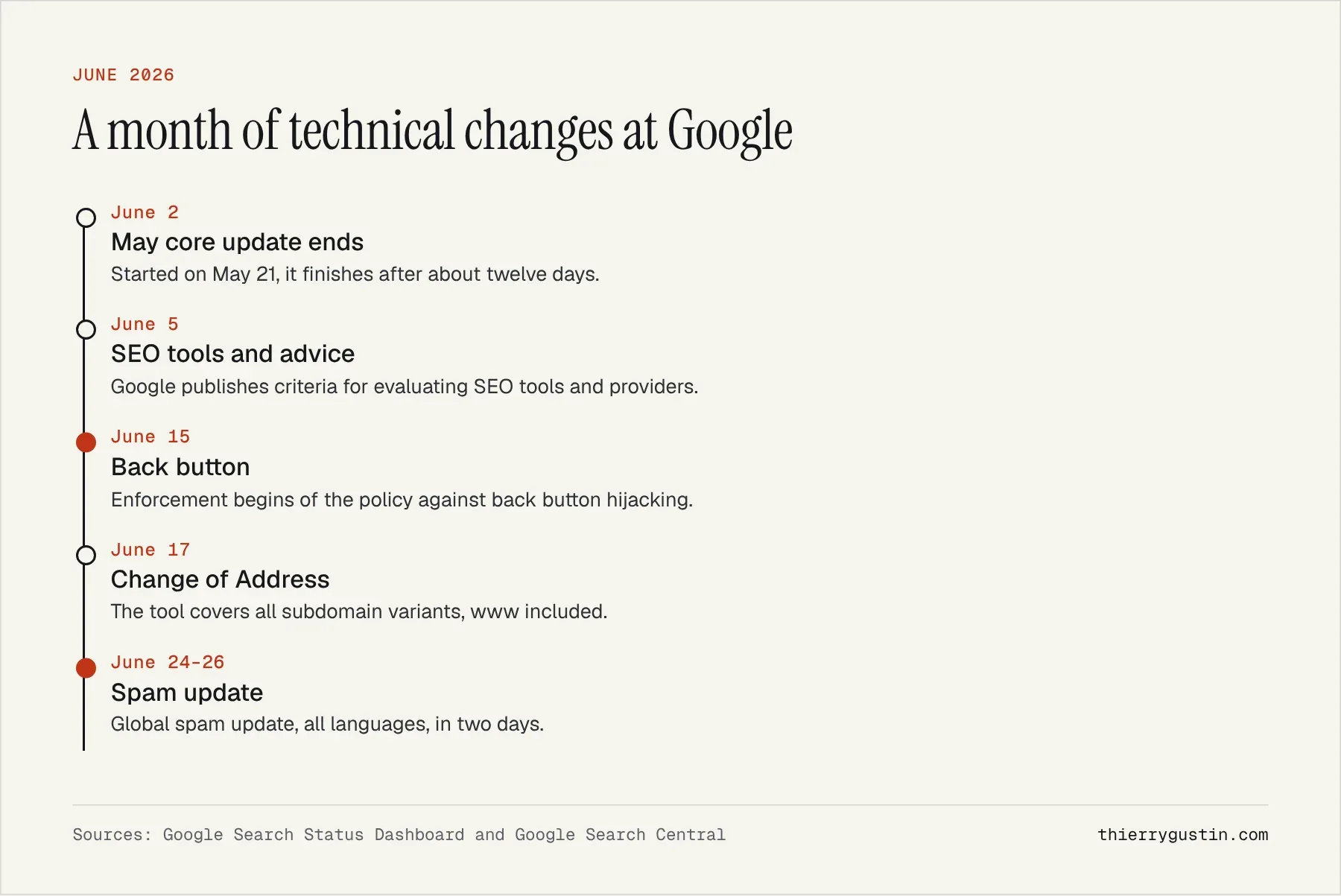
The June 2026 spam update rolled out from 9 a.m. on June 24 to 10 a.m. on June 26 (Pacific Time), that is, from 6 p.m. on June 24 to 7 p.m. on June 26 in Paris and Madrid, across all languages and countries.[1] Google didn't say what it was targeting. If your traffic dropped in late June, you need to check three things before drawing conclusions: the June 2026 spam update itself, the end of the May core update on June 2, and the back button hijacking policy, enforced since June 15.
June was a busy month for anyone running a website. Not spectacular, but dense: the end of a major update, a new spam policy coming into force, a spam update, and several documentation clarifications affecting site moves and SEO tools. Looking back from November, here is how to untangle these events, along with the technical checklist I apply to my clients' sites.
What happened at Google in June 2026?
Five dates are enough to reconstruct the month. They matter because a traffic drop can only be interpreted in light of what changed at Google at the same time.
Did the June spam update hit your site?
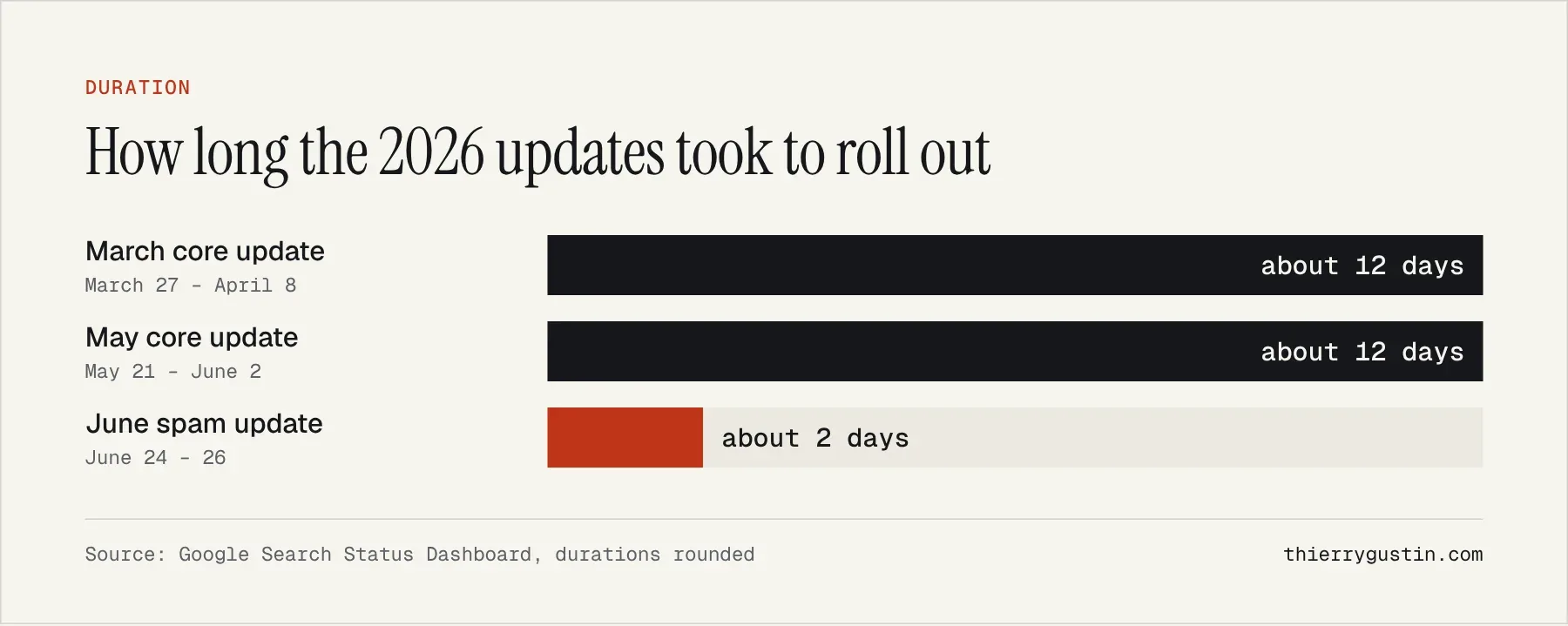
A spam update doesn't look like a core update. The June one was wrapped up in about two days, whereas the March and May core updates each took around twelve days.[1][2][5] An effect linked to the spam update therefore shows up as a sharp step down between June 24 and 27, not as a slide over two weeks.
My diagnostic method is simple. In Search Console, set the Performance report to a daily view from June 1 to July 15 and add three markers: June 2, June 15 and June 24. A slow decline that levels off in early June points to the May core update, which I cover in my column on the May core update. A sudden step down around June 25 points to the spam update.
Next, open the “Manual actions” report. A spam update is algorithmic and leaves no message; a manual action does. This distinction has mattered more since April: Google said on April 14 that it could now use spam reports to take manual actions.[4] An annoyed competitor can therefore trigger a human review of your site.
Back button hijacking: what has been penalized since June 15?
Google defines back button hijacking as interfering with browser navigation to prevent users from returning to the previous page, for example by inserting pages into the browser history or redirecting them to unsolicited pages or ads. Announced on April 13, the policy has been enforced since June 15. Affected pages are exposed to manual actions or automated demotions.[3]
The point that directly concerns small businesses: Google specifies that the issue can come “from libraries included by the site or from its advertising platform”.[3] In other words, you can be in violation without having written a single faulty line of code. A pop-up plugin, an ad network script or a “recommended content” widget is enough. I've written a full article on back button hijacking with a method for auditing your scripts.
The required fix is clear: remove or disable the responsible code, imports or settings, then, if there was a manual action, submit a reconsideration request in Search Console.[3]
Domain migration: what does the June 17 clarification change?
On June 17, Google clarified in its site move documentation that the Change of Address tool applies to all subdomain variants, including the www and non-www versions.[4] It sounds like a detail. Yet in the migrations I take over after the fact, it's a common mistake: the main version redirects cleanly, but the forgotten variant lives on with its own signals.
If you're changing your domain name, for example moving from a .es to a .com as you expand into France, list every variant that has received traffic or links before the switch: www and non-www, http and https, old subdomains. Each one must 301-redirect to the equivalent URL on the new domain, page by page, not to the home page.
Which other June clarifications deserve your attention?
On June 5, Google added guidance to its documentation on evaluating third-party SEO tools, services and recommendations, and expanded its page on hiring an SEO.[4] On June 15, it stated in black and white that llms.txt files are not needed for its Search and neither help nor hurt rankings, and it removed the documentation for FAQ rich results, which are no longer shown.[4]
Add to that a broader scope for spam: since May 15, Google's definition of spam includes attempts to manipulate generative AI answers in its Search.[4] Techniques sold as “GEO quick wins”, such as artificial mentions or pages fabricated to be picked up by AI, therefore fall into the same category as the old link networks.
For a small business buying services, the consequence is practical. When a tool or an agency recommends a special file for AI, a miracle markup or a mention campaign, ask which official documentation the recommendation is based on. In June 2026, Google itself provided the criteria for asking that question.
My take: technical SEO is back to basic hygiene
What strikes me, looking back at June, is how consistent it all is. Google isn't asking anything new of honest sites. It is tightening penalties against whatever degrades the user experience, cleaning out documentation that no longer serves a purpose, and reminding everyone that miracle recipes for AI aren't miracles. I go into this further in my article on technical SEO myths in the age of AI.
The real risk for a small business isn't being a spammer; it's unknowingly hosting someone else's code. The average WordPress or Shopify site loads scripts from several vendors. Any of them can change behavior overnight, and you're the one Google penalizes.
What should you do in practice?
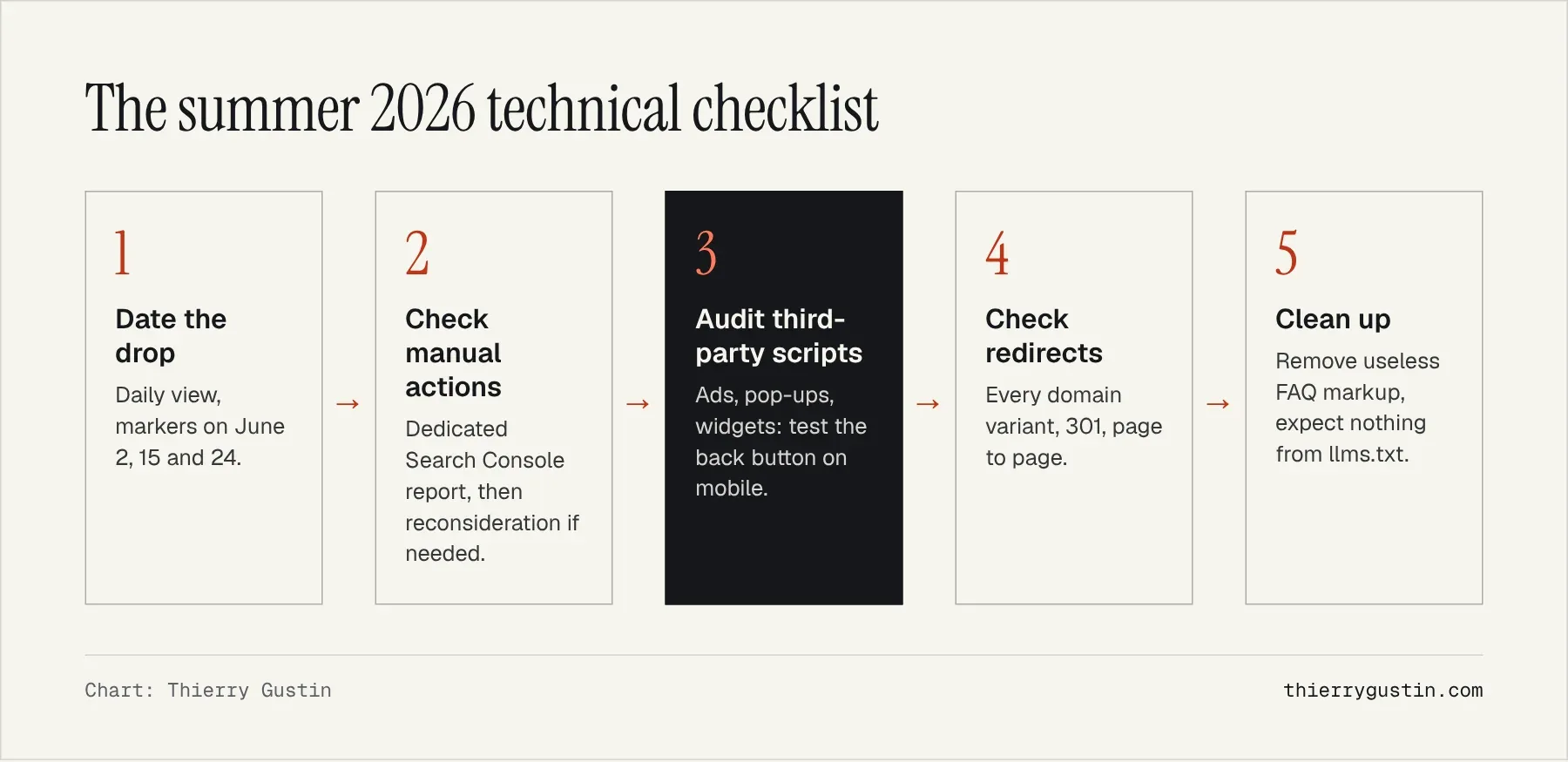
For the scripts step, nothing beats a manual test: open your most visited pages from a Google result on a phone, then tap back. You should land back on the results, on the first try. For redirects, a crawler such as Arachnide, the open-source tool I maintain, lets you check in a single pass where each old URL ends up.
Frequently asked questions
When was the June 2026 spam update?
According to Google's dashboard, it started on June 24, 2026 at 9 a.m. and ended on June 26 at 10 a.m. Pacific Time, that is, from 6 p.m. on June 24 to 7 p.m. on June 26 in Paris and Madrid. It applied to all languages and all countries, and Google didn't detail which practices it targeted.
How do I know if my site was hit by the spam update?
Look at the Search Console Performance report in daily view. A clear drop between June 24 and 27, with no other change on your side, is a strong indication. Also check the Manual actions report: a spam update doesn't send a message, a manual action does.
Can my site be penalized because of an ad script?
Yes. For back button hijacking, penalized since June 15, 2026, Google specifies that the issue can come from included libraries or from the site's advertising platform. The site owner remains responsible and must remove the offending code and request reconsideration if there was a manual action.
Do I need to include both www and non-www versions in a site migration?
Since the June 17, 2026 clarification, Google says the Change of Address tool applies to all subdomain variants, www and non-www. Each variant still has to 301-redirect to the equivalent URL on the new domain, page by page.
Sources
- Google Search Status Dashboard, “June 2026 spam update” (June 24–26, 2026)
- Google Search Status Dashboard, May 2026 core update (May 21 – June 2, 2026)
- Google Search Central, new policy against back button hijacking (April 13, 2026)
- Google Search Central, documentation updates log (entries for April 14, May 15, and June 5, 15 and 17, 2026)
- Google Search Status Dashboard, March 2026 core update (March 27 – April 8, 2026)
Read next
My Vision of SEO and GEO for 2027: Seven Theses and an Action Plan
SEO in 2027: my vision of SEO and GEO in seven sourced theses, the 2026–2027 timeline and the action plan small businesses should start right now.