68% of Google searches end without a click: what should a small business do in 2026?
 By Thierry Gustin
Updated
6 min read
Contents
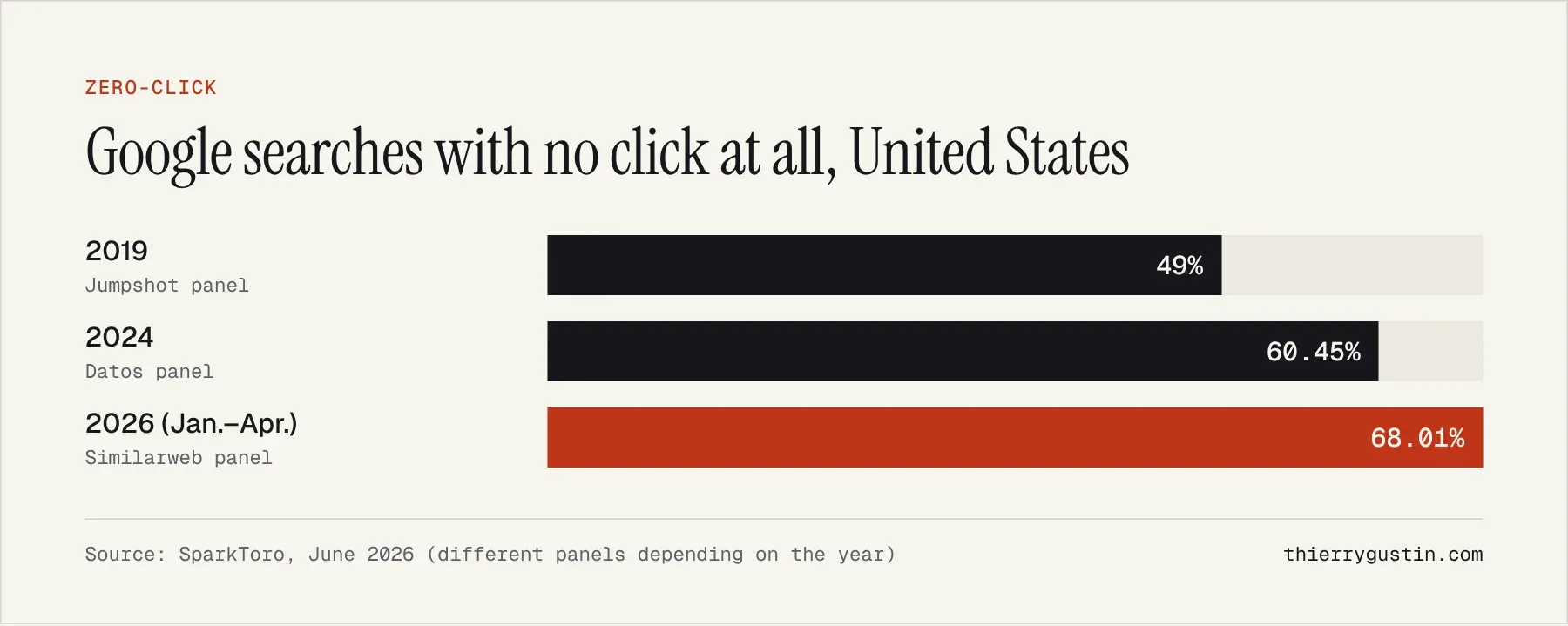
In June 2026, SparkToro published the figure that went around the whole industry: 68.01% of Google searches made in the United States between January and April 2026 ended without a single click, up from 60.45% in 2024.[1] Zero-click search is becoming the norm, but that U.S. figure doesn't mean your site has lost two-thirds of its traffic. For a small business, the answer is to exist within the answer itself, then to convert the remaining clicks better.
The issue isn't theoretical in France or Spain either. Since July 22, 2026, AI Overviews and AI Mode have been live in France, and the first French measurements show clicks falling on the most exposed sites. Looking back from November, here is how to read these figures honestly and what I advise my clients.
What exactly does the 68% zero-click figure measure?
The study, by Rand Fishkin, is based on Similarweb's clickstream panel, on desktop and mobile, in the United States, from January to April 2026. “Zero-click” is defined broadly: no visit of any kind after the search, whether to a website, an ad or another Google property.[1]
Three caveats apply. The 2024 figures come from a different panel, Datos, and the 2019 ones from Jumpshot, which no longer exists: the author himself admits he's comparing apples and oranges. Next, on mobile, only searches made in the browser are counted, not those in the Google app; Fishkin therefore believes the true rate is probably higher. Finally, some “non-clicks” turn into a new search: that behavior is up 7.2 points since 2024.[1]
One detail deserves attention: over the same period, only 0.34% of the searches observed went through AI Mode.[1] The rise in zero-click searches therefore isn't explained by a mass exodus to AI Mode. My interpretation: it comes mostly from everything Google now displays directly on its results page, from AI Overviews to answer boxes and maps.
And what does the data say for France?
To my knowledge, there is no French equivalent of the SparkToro study. The best measurement available is the one from Ahrefs, published on September 16, 2026, covering 963 French domains based on aggregated Search Console data. It compares the 28 days before July 22 with the 9 days after.[3]
Across the whole panel, click-through rate fell by 3.4% and median clicks by 8.8%. But the effect is concentrated: among the domains most exposed to AI Overviews, median click-through rate dropped by 23.1%, and by 24.8% once adjusted against the control group. Domains ending in .fr lost 12.3% of their clicks at the median, and health, the most exposed sector, saw its click-through rate fall by 20.4%.[3]
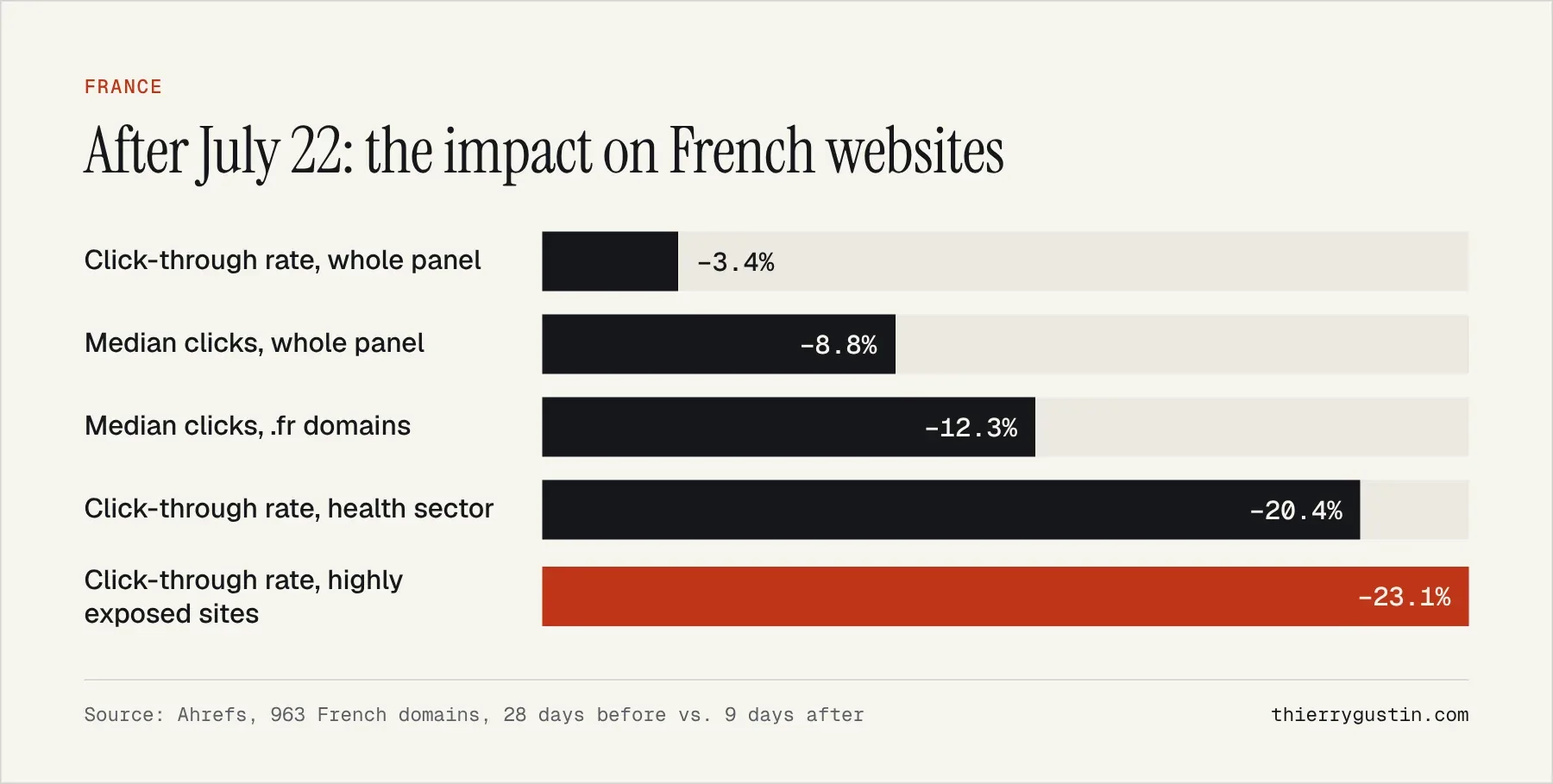
Ahrefs warns that nine days is short and that late July has its own seasonality. The signal is nonetheless consistent with the U.S. data: impressions barely moved for most sites while clicks fell.[3] You remain visible; people just click on you less. To track that exposure page by page, use the new AI report in Search Console.
Is a search without a click necessarily lost?
No, and this is the point many business owners miss. A zero-click search where your brand appears in the answer doesn't have the same value as one where it's absent. The Seer Interactive study illustrates this for informational queries: in 2025, a brand cited in the AI Overview got an organic click-through rate of 2.07%, compared with 0.94% when it wasn't cited.[4] Seer notes that this is a correlation, and that one very large account drags the second figure down; without it, it would be about 1.61%.[4]
Search itself is also shifting. In the United States, 49% of adults had already used a chatbot by February 2026, and 66% of 18- to 29-year-olds.[2] Some of the questions that used to go through Google are probably now being asked of ChatGPT or Gemini, often without a click either. Assistants built into the phone, such as Siri AI, announced by Apple in June, will extend this trend, even though it isn't coming to EU iPhones right away.
My take: traffic is no longer the right thermometer
I don't believe SEO is dead, but I do believe one metric is: the number of sessions coming from Google. For a small business, that figure lumped together visitors looking for a definition and others looking for a provider. The first group is disappearing; the second remains, because they have to act on a website to get a quote, make a booking or buy.
My reading of the 2026 data is therefore as follows. Informational content now serves first and foremost to get cited, and the click becomes a bonus. High-intent pages, such as services, pricing, case studies or local pages, drive revenue. A law firm or an accountant, for example, will lose visits on its explainer articles, but not on “employment lawyer Manchester”. I discuss this case on my page about GEO for professional services.
What should you do about zero-click search?
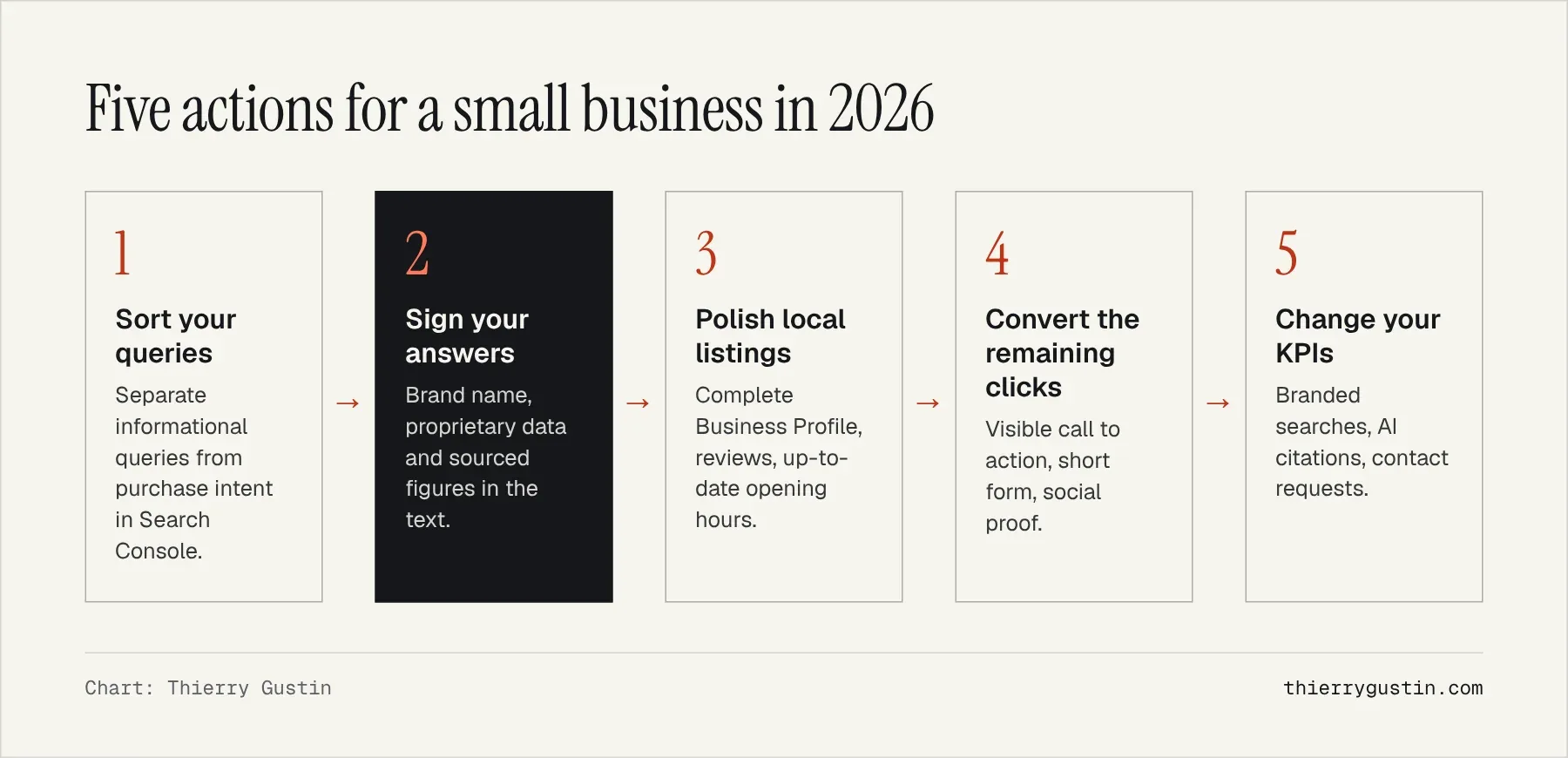
The second point is the most underrated. A generated answer reuses facts; if your facts are generic, any source will do. If you publish data that only you have, such as an average response time, an observed price or a client result, the answer has a reason to name you. That's the best insurance against zero-click.
The fourth point is the most profitable in the short term. When clicks become scarce, gaining two points of conversion on the visitors who do arrive often offsets part of the drop. To see where you stand, the full study of traffic figures is in my article on the impact of AI Overviews.
Frequently asked questions
What is a zero-click search?
It's a search after which the user doesn't click on any result: no website, no ad, no other Google service. They get their answer on the results page, give up or run another search. According to SparkToro, that was the case for 68.01% of Google searches in the United States between January and April 2026.
Does the 68% zero-click figure apply outside the U.S.?
No, it covers the United States, with a panel that doesn't count the Google app on mobile. For France, the best available measurement is the Ahrefs study from September 2026: after AI Overviews arrived, median clicks fell by 8.8% across 963 domains and click-through rate by 23.1% on the most exposed sites.
Which industries are hit hardest by zero-click searches?
Those whose content answers general questions. In France, Ahrefs observed the sharpest drop in health, with click-through rate down 20.4% and the highest AI Overview rate in the panel. Transactional and local queries hold up better, because the user has to visit a website to take action.
How do I measure the impact of zero-click on my website?
In Search Console, compare how impressions and clicks change page by page: stable impressions with falling clicks signal an answer displayed without a click. Also track searches for your brand name, your citations in AI assistants and, above all, your contact requests.
Sources
- SparkToro, “In 2026, less than one third of Google searches still send a click” (June 9, 2026, updated June 18)
- Pew Research Center, “Why don't people use chatbots?” (June 17, 2026)
- Ahrefs, “AI Overviews Cut CTR by 23.1% in France” (September 16, 2026)
- Seer Interactive, impact of AI Overviews on click-through rate, 2026 update (April 24, 2026)
Read next
My Vision of SEO and GEO for 2027: Seven Theses and an Action Plan
SEO in 2027: my vision of SEO and GEO in seven sourced theses, the 2026–2027 timeline and the action plan small businesses should start right now.